PYGMALION (MYTHOLOGY)
Pygmalion is a legendary figure of Cyprus. Though Pygmalion is the Greek version of the Phoenician royal name Pumayyaton,[notes 2] he is most familiar from Ovid's narrative poem Metamorphoses, in which Pygmalion was a sculptor who fell in love with a statue he had carved. Pygmalion was a Cypriot sculptor who carved a woman out of ivory. According to Ovid, after seeing the Propoetides he was "not interested in women", but his statue was so beautiful and realistic that he fell in love with it.
 |
| Pygmalion and Galatea (statue) |
 PYGMALION (PLAY)
Pygmalion is a play by George Bernard Shaw, named after a Greek mythological character. It was first presented on stage to the public in 1913.
Professor of phonetics Henry Higgins makes a bet that he can train a bedraggled Cockney flower girl, Eliza Doolittle, to pass for a duchess at an ambassador's garden party by teaching her to assume a veneer of gentility, the most important element of which, he believes, is impeccable speech. The play is a sharp lampoon of the rigid British class system of the day and a commentary on women's independence.
In ancient Greek mythology, Pygmalion fell in love with one of his sculptures, which then came to life.
The general idea of that myth was a popular subject for Victorian era English playwrights, based on the story called Pygmalion and Galatea first presented in 1871. Shaw would also have been familiar with the burlesque version, Galatea, or Pygmalion Reversed.
TIRESIAS
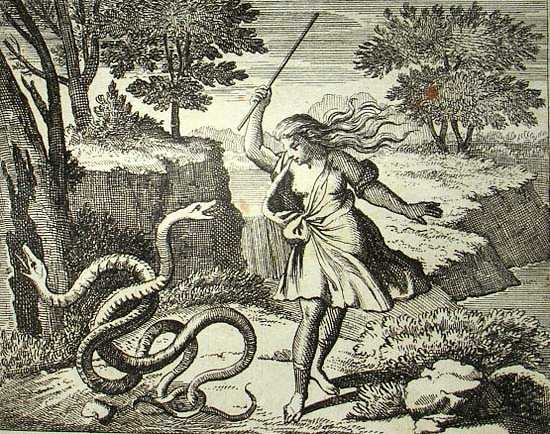 |
| Tiresias strikes two snakes with a stick, and is transformed into a woman by Hera. |
In Greek mythology, Tiresias was a blind prophet of Apollo in Thebes, famous for clairvoyance and for being transformed into a woman for seven years. He was the son of the shepherd Everes and the nymph Chariclo. Tiresias participated fully in seven generations at Thebes, beginning as advisor to Cadmus himself.
Eighteen allusions to mythic Tiresias, noted by Luc Brisson, fall into three groups: one, in two episodes, recounts Tiresias' sex-change and his encounter with Zeus and Hera; a second group recounts his blinding by Athena; a third, all but lost, seems to have recounted the misadventures of Tiresias.
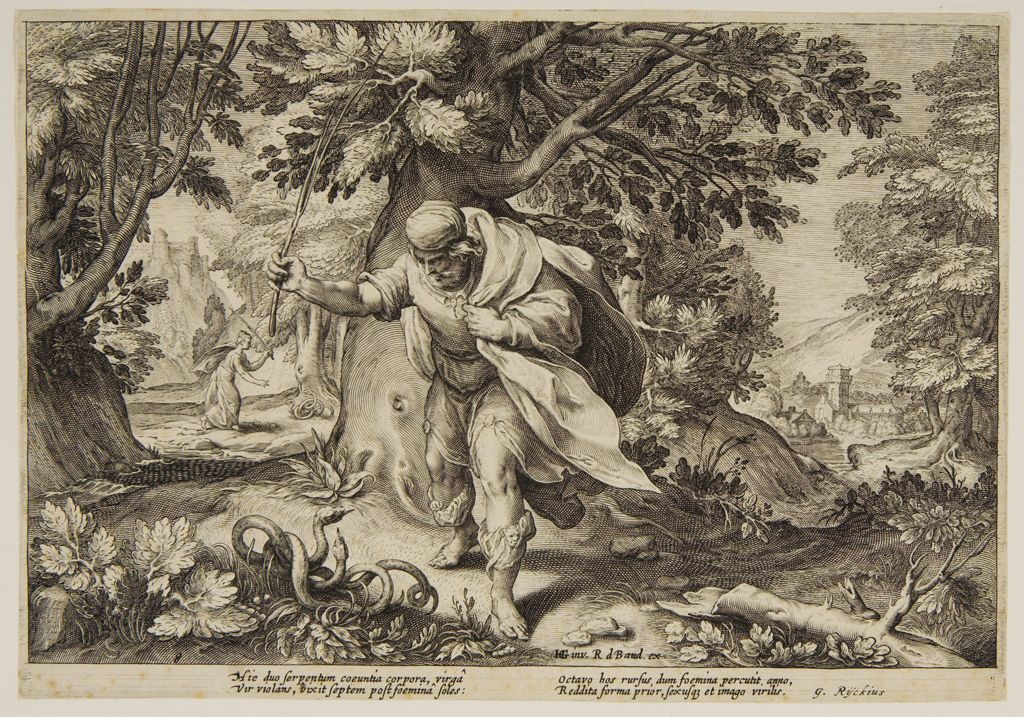 |
| Tiresias smashing two copulating snakes with a stick. Notice that the female Tiresias is in the back. |
ORPHEUS
Orpheus was a legendary musician, poet, and prophet in ancient Greek religion and myth. The major stories about him are centered on his ability to charm all living things and even stones with his music, his attempt to retrieve his wife, Eurydice, from the underworld, and his death at the hands of those who could not hear his divine music.
As an archetype of the inspired singer, Orpheus is one of the most significant figures in the reception of classical mythology in Western culture, portrayed or alluded to in countless forms of art and popular culture including poetry, film, opera, music, and painting. For the Greeks, Orpheus was a founder and prophet of the so-called "Orphic" mysteries. He was credited with the composition of the Orphic Hymns, a collection of which only two have survived. Shrines containing purported relics of Orpheus were regarded as oracles. Some ancient Greek sources note Orpheus' Thracian origins.
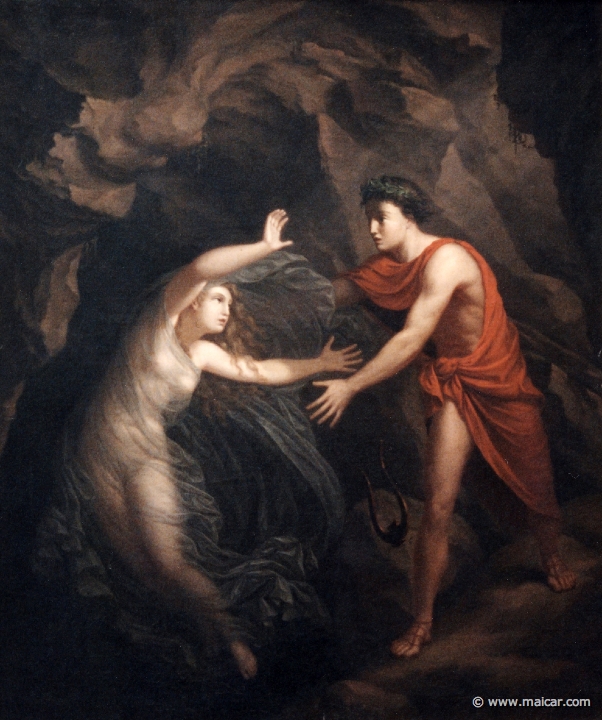 |
| Orpheus with his wife while leaving the Underworld. 5125 |
 |
| Orphues and Eurydice |
KING MIDAS
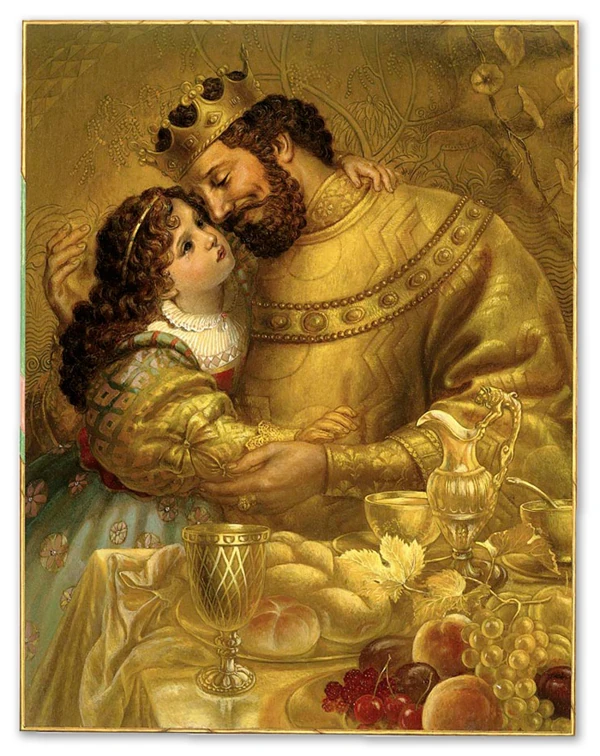 |
| King Midas and his Daughter |
Midas is the name of at least three members of the royal house of Phrygia.
The most famous King Midas is popularly remembered in Greek mythology for his ability to turn everything he touched into gold. This came to be called the golden touch, or the Midas touch. The Phrygian city Midaeum was presumably named after this Midas, and this is probably also the Midas that according to Pausanias founded Ancyra. According to Aristotle, legend held that Midas died of starvation as a result of his "vain prayer" for the gold touch. The legends told about this Midas and his father Gordias, credited with founding the Phrygian capital city Gordium and tying the Gordian Knot, indicate that they were believed to have lived sometime in the 2nd millennium BC, well before the Trojan War.

** PREFIX, ROOT, SUFFIX **
en-/em- : near, at, in, on, within, into
enlarge : to make something larger
encourage : to make someone more determined
empower : to give power to
ob- / op- : toward, against, across, down
obstacle : something that makes it difficult
opponent : rival
opposite : located at another side
omni- : all
omnipresent : present in all places at all the time
omnipotent : having complete or unlimited power
omniscient : knowing everything
pro- : many, much, in favor of
prolific : producing a large amount of something
proliferate : to increase in number or amount quickly
proponent : a person who argues for a supports
-potent : ability
impotent : powerless, weak, incapable of doing something
incompetent : without a complete ability
plenipotentiary : having full power
se- : without, apart from
segregation : a practice or policy that separate people of different racers or religions
separate : drawn apart
select : to choose
voc - : voice, say, call
vocal : spoken, oral
vocation : a strong desire to spend your life doing a certain kind of work
vocative : showing the person or thing to spoken to

No comments:
Post a Comment