ELECTRA COMPLEX
"Daddy's girl" and "Daddy's little girl" redirect here. For other uses, see Daddy's Girl (disambiguation) and Daddy's Little Girl (disambiguation).
In Neo-Freudian psychology, the Electra complex, as proposed by Carl Gustav Jung, is a girl's psychosexual competition with her mother for possession of her father. In the course of her psychosexual development, the complex is the girl's phallic stage; formation of a discrete sexual identity, a boy's analogous experience is the Oedipus complex. The Electra complex occurs in the third—phallic stage (ages 3–6)—of five psychosexual development stages: (i) the Oral, (ii) the Anal, (iii) the Phallic, (iv) the Latent, and (v) the Genital—in which the source libido pleasure is in a different erogenous zone of the infant’s body.
In classical psychoanalytic theory, the child's identification with the same-sex parent is the successful resolution of the Electra complex and of the Oedipus complex; his and her key psychological experience to developing a mature sexual role and identity. Sigmund Freud instead proposed that girls and boys resolved their complexes differently—she via penis envy, he via castration anxiety; and that unsuccessful resolutions might lead to neurosis and homosexuality.[citation needed] Hence, women and men who are fixated in the Electra and Oedipal stages of their psychosexual development
might be considered "father-fixated" and "mother-fixated" as revealed
when the mate (sexual partner) resembles the father or the mother.

OEDIPUS COMPLEX
 |
| Oedipus and the Sphinx, by Gustave Moreau, (1864) |
In psychoanalysis, the Oedipus Complex (or, less commonly, Oedipal complex) is a child's desire, that the mind keeps in the unconscious via dynamic repression, to have sexual relations with the parent of the opposite sex (i.e. males attracted to their mothers, and females attracted to their fathers).
The Oedipus complex occurs in the third—phallic stage (ages 3–6)—of the five psychosexual development stages: (i) the oral, (ii) the anal, (iii) the phallic, (iv) the latent, and (v) the genital—in which the source of libidinal pleasure is in a different erogenous zone of the infant's body. The Oedipal complex originally refers to the sexual desire of a son for his mother and does not have to be reciprocated.
The Oedipus complex occurs in the third—phallic stage (ages 3–6)—of the five psychosexual development stages: (i) the oral, (ii) the anal, (iii) the phallic, (iv) the latent, and (v) the genital—in which the source of libidinal pleasure is in a different erogenous zone of the infant's body. The Oedipal complex originally refers to the sexual desire of a son for his mother and does not have to be reciprocated.
Sigmund Freud, who coined the term "Oedipus complex", believed that the Oedipus complex is a desire for the parent in both males and females; he deprecated the term "Electra complex", which was introduced by Carl Gustav Jung in regard to the Oedipus complex manifested in young girls. Freud further proposed that boys and girls experience the complex differently: boys in a form of castration anxiety, girls in a form of penis envy; and that unsuccessful resolution of the complex might lead to neurosis, pedophilia, and homosexuality. A child's identification with the same-sex parent is the successful resolution of the complex.
Men and women who are fixated in the Oedipal and Electra stages of their psychosexual development might be considered "mother-fixated" and "father-fixated." In adult life, this can lead to a choice of a sexual partner who resembles one's parent.
AGAMEMNON
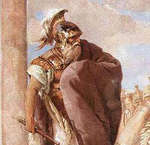
In Greek mythology, Agamemnon was the son of King Atreus and Queen Aerope of Mycenae, the brother of Menelaus, the husband of Clytemnestra and the father of Iphigenia, Electra or Laodike (Λαοδίκη), Orestes and Chrysothemis. Mythical legends make him the king of Mycenae or Argos, thought to be different names for the same area. When Helen, the wife of Menelaus, was taken to Troy by Paris, Agamemnon commanded the united Greek armed forces in the ensuing Trojan War.
Upon Agamemnon's return from Troy, he was murdered (according to the oldest surviving account, Odyssey 11.409–11) by Aegisthus,
the lover of his wife, Clytemnestra. In old versions of the story, the
scene of the murder, when it is specified, is usually the house of
Aegisthus, who has not taken up residence in Agamemnon's palace, and it
involves an ambush and the deaths of Agamemnon's followers as well. In
some later versions Clytemnestra herself does the killing, or they act
together as accomplices, killing Agamemnon in his own home.
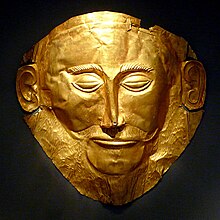 |
| The Mask of Agamemnon |
ORESTEIA
The Oresteia is a trilogy of Greek tragedies written by Aeschylus concerning the murder of Agamemnon by Clytaemnestra, the murder of Clytaemnestra by Orestes, the trial of Orestes, the end of the curse on the House of Atreus and pacification of the Erinyes. This trilogy also shows how the Greek gods interacted with the characters and influenced their decisions pertaining to events and disputes. The only extant example of an ancient Greek theater trilogy, the Oresteia won first prize at the Dionysia festival in 458 BC. Many consider the Oresteia to be Aeschylus' finest work. The principal themes of the trilogy include the contrast between revenge and justice, as well as the transition from personal vendetta to organized litigation.

AESCHYLUS
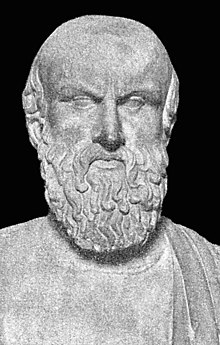 |
| Bust of Aeschylus from the Capitoline Museums, Rome |
Only seven of his estimated seventy to ninety plays have survived, and there is a longstanding debate regarding his authorship of one of these plays, Prometheus Bound, which some believe his son Euphorion actually wrote. Fragments of some other plays have survived in quotes and more continue to be discovered on Egyptian papyrus, often giving us surprising insights into his work. He was probably the first dramatist to present plays as a trilogy; his Oresteia is the only ancient example of the form to have survived. At least one of his plays was influenced by the Persians' second invasion of Greece (480–479 BC). This work, The Persians, is the only surviving classical Greek tragedy concerned with contemporary events (very few of that kind were ever written), and a useful source of information about its period. The significance of war in Ancient Greek culture was so great that Aeschylus' epitaph commemorates his participation in the Greek victory at Marathon while making no mention of his success as a playwright. Despite this, Aeschylus' work – particularly the Oresteia – is acclaimed by today's literary academics.
EXTRA INFORMATION
~Flashforward
A flashforward (also spelled flash-forward; also called a prolepsis) is a scene that temporarily takes the narrative forward in time from the current point of the story in literature, film, television and other media. Flashforwards are often used to represent events expected, projected, or imagined to occur in the future. They may also reveal significant parts of the story that have not yet occurred, but soon will in greater detail. It is similar to foreshadowing, in which future events are not shown but rather implicitly hinted at. It is primarily a postmodern narrative device, named by analogy to the more traditional flashback (or analepsis), which reveals events that occurred in the past.
~Flashback
A flashback is a transition in a story to an earlier time, that interrupts the normal chronological order of events. A flashback in a movie might show what happened when a character was younger.
Flashbacks are often used for comedic effect, to prove or contradict something in the present. For example, if a character in a sitcom claims he does the dishes every single night, flashbacks could show him ignoring a giant pile of dirty dishes on various occasions. Flashback can also mean a sudden, vivid remembrance of past events, like having a flashback to your kindergarten days if you go visit that classroom today.


No comments:
Post a Comment