DIASPORA
A diaspora (from Greek διασπορά, "scattering, dispersion") is a scattered population whose origin lies within a smaller geographic locale. Diaspora can also refer to the movement of the population from its original homeland. Diaspora has come to refer particularly to historical mass dispersions of an involuntary nature, such as the expulsion of Jews from Judea, the fleeing of Greeks after the fall of Constantinople, the African Trans-Atlantic slave trade, the southern Chinese or Hindus of South Asia during the coolie trade, the Irish during and after the Irish Famine, the displacement of Palestinians in the 20th century, the exile and deportation of Circassians, and the emigration of Anglo-Saxon warriors and their families after the Norman Conquest of England, many of whom found employment in Constantinople and bolstered the elite bodyguard of the emperor, the Varangian Guard.
Recently, scholars have distinguished between different kinds of diaspora, based on its causes such as imperialism, trade or labor migrations, or by the kind of social coherence within the diaspora community and its ties to the ancestral lands. Some diaspora communities maintain strong political ties with their homeland. Other qualities that may be typical of many diasporas are thoughts of return, relationships with other communities in the diaspora, and lack of full integration into the host country.

ORIGINAL SIN
Original sin, also called ancestral sin, is the Christian doctrine of humanity's state of sin resulting from the fall of man, stemming from Adam and Eve's rebellion in Eden, namely the sin of disobedience in consuming from the tree of knowledge of good and evil.
The concept of original sin was first alluded to in the 2nd century by Irenaeus, Bishop of Lyon in his controversy with certain dualistGnostics. Other church fathers such as Augustine also developed the doctrine,[2] seeing it as based on the New Testament teaching of Paul the Apostle (Romans5:12–21 and 1 Corinthians15:22) and the Old Testament verse of Psalms51:5. Tertullian, Cyprian, Ambrose and Ambrosiaster considered that humanity shares in Adam's sin, transmitted by human generation. Augustine's formulation of original sin was popular among Protestant reformers, such as Martin Luther and John Calvin, who equated original sin with concupiscence, affirming that it persisted even after baptism and completely destroyed freedom. The Jansenist movement, which the Catholic Church declared to be heretical, also maintained that original sin destroyed freedom of will.
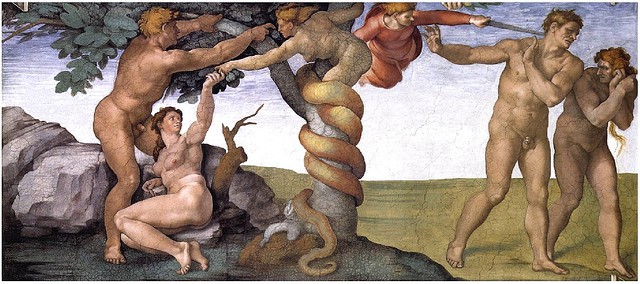 |
| Original Sin |
The
story of the Garden of Eden and the Fall of Man represents a tradition
among the Abrahamic peoples, with a presentation more or less symbolical
of certain moral and religious truths.
THE FREE WILL
 Free will is the ability to choose between different possible courses of action. It is closely linked to the concepts of responsibility, praise, guilt, sin, and other judgments which apply only to actions that are freely chosen. It is also connected with the concepts of advice, persuasion, deliberation, and prohibition. Traditionally, only actions that are freely willed are seen as deserving credit or blame. There are numerous different concerns about threats to the possibility of free will, varying by how exactly it is conceived, which is a matter of some debate.
 Some conceive free will to be the capacity to make choices in which the outcome has not been determined by past events. Determinism suggests that only one course of events is possible, which is inconsistent with the existence of such free will. This problem has been identified in ancient Greek philosophy,[1] and remains a major focus of philosophical debate. This view that conceives free will to be incompatible with determinism is called incompatibilism, and encompasses both metaphysical libertarianism, the claim that determinism is false and thus free will is at least possible, and hard determinism, the claim that determinism is true and thus free will is not possible. It also encompasses hard incompatibilism, which holds not only determinism but also its negation to be incompatible with free will, and thus free will to be impossible whatever the case may be regarding determinism.
SERPENTS IN THE BIBLE
Serpents are referred to in both the Hebrew Bible and the New Testament. The symbol of a serpent or snake played important roles in religious and cultural life of ancient Egypt, Canaan, Mesopotamia and Greece. The serpent was a symbol of evil power and chaos from the underworld as well as a symbol of fertility, life and healing. Nachash, Hebrew for "snake", is also associated with divination, including the verb-form meaning to practice divination or fortune-telling. In the Hebrew Bible, Nachash occurs in the Torah to identify the serpent in Eden. Throughout the Hebrew Bible, it is also used in conjunction with saraph to describe vicious serpents in the wilderness. Tanniyn, a form of dragon-monster, also occurs throughout the Hebrew Bible. In the Book of Exodus, the staffs of Moses and Aaron are turned into serpents, a nachash for Moses, a tanniyn for Aaron. In the New Testament, the Book of Revelation makes use of ancient serpent and the Dragon several times to identify Satan or the devil. (Rev 12:9; 20:2) The serpent is most often identified with the hubristicSatan, and sometimes with Lilith.
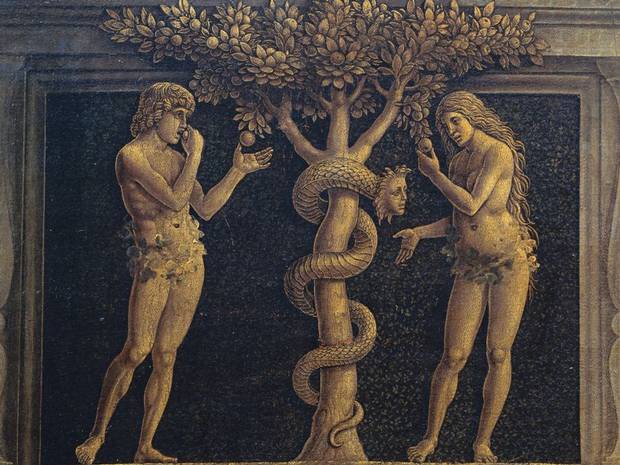 |
| Adam, Eve and Serpents |
BETHLEHEM
Bethlehem , "House of Meat", "House of Bread"; is a Palestinian city located in the central West Bank, Palestine, about 10 km (6.2 miles) south of Jerusalem. Its population is approximately 25,000 people. It is the capital of the Bethlehem Governorate. The economy is primarily tourist-driven.
The earliest known mention of the city was in the Amarna correspondence of 1350–1330 BCE during its habitation by the Canaanites. The Hebrew Bible, which says that the city of Bethlehem was built up as a fortified city by Rehoboam, identifies it as the city David was from and where he was crowned as the king of Israel. The New Testament identifies Bethlehem as the birthplace of Jesus. Bethlehem was destroyed by the Emperor Hadrian during the second-century Bar Kokhba revolt; its rebuilding was promoted by Empress Helena, mother of Constantine the Great, who commissioned the building of its great Church of the Nativity in 327 CE. The church was badly damaged by the Samaritans, who sacked it during a revolt in 529, but was rebuilt a century later by Emperor Justinian I.
The earliest known mention of the city was in the Amarna correspondence of 1350–1330 BCE during its habitation by the Canaanites. The Hebrew Bible, which says that the city of Bethlehem was built up as a fortified city by Rehoboam, identifies it as the city David was from and where he was crowned as the king of Israel. The New Testament identifies Bethlehem as the birthplace of Jesus. Bethlehem was destroyed by the Emperor Hadrian during the second-century Bar Kokhba revolt; its rebuilding was promoted by Empress Helena, mother of Constantine the Great, who commissioned the building of its great Church of the Nativity in 327 CE. The church was badly damaged by the Samaritans, who sacked it during a revolt in 529, but was rebuilt a century later by Emperor Justinian I.
 |
| Bethlehem - The Birth of Jesus |
SODOM AND GOMORRAH
Sodom and Gomorrah were cities mentioned in the Book of Genesis and throughout the Hebrew Bible, the New Testament and in the deuterocanonical books, as well as in the Quran and the hadith.
According to the Torah, the kingdoms of Sodom and Gomorrah were allied with the cities of Admah, Zeboim and Bela. These five cities, also known as the "cities of the plain", (from Genesis in the Authorized Version) were situated on the Jordan River plain in the southern region of the land of Canaan. The plain, which corresponds to the area just north of the modern-day Dead Sea,was compared to the garden of Eden[Gen.13:10] as being a land well-watered and green, suitable for grazing livestock.
Divine judgment by God was then passed upon Sodom and Gomorrah and two neighboring cities, which were completely consumed by fire and brimstone. Neighboring Zoar (Bela) was the only city to be spared. In Abrahamic religions, Sodom and Gomorrah have become synonymous with impenitent sin, and their fall with a proverbial manifestation of divine retribution. Sodom and Gomorrah have been used as metaphors for vice and homosexuality viewed as a deviation. The story has therefore given rise to words in several languages. These include the English word sodomy, used in sodomy laws to describe sexual "crime against natures", namely anal or oral sex (either homosexual or heterosexual), or bestiality. Some Islamic societies incorporate punishments associated with Sodom and Gomorrah into sharia.
According to the Torah, the kingdoms of Sodom and Gomorrah were allied with the cities of Admah, Zeboim and Bela. These five cities, also known as the "cities of the plain", (from Genesis in the Authorized Version) were situated on the Jordan River plain in the southern region of the land of Canaan. The plain, which corresponds to the area just north of the modern-day Dead Sea,was compared to the garden of Eden[Gen.13:10] as being a land well-watered and green, suitable for grazing livestock.
Divine judgment by God was then passed upon Sodom and Gomorrah and two neighboring cities, which were completely consumed by fire and brimstone. Neighboring Zoar (Bela) was the only city to be spared. In Abrahamic religions, Sodom and Gomorrah have become synonymous with impenitent sin, and their fall with a proverbial manifestation of divine retribution. Sodom and Gomorrah have been used as metaphors for vice and homosexuality viewed as a deviation. The story has therefore given rise to words in several languages. These include the English word sodomy, used in sodomy laws to describe sexual "crime against natures", namely anal or oral sex (either homosexual or heterosexual), or bestiality. Some Islamic societies incorporate punishments associated with Sodom and Gomorrah into sharia.

SAMUEL JOSHUA
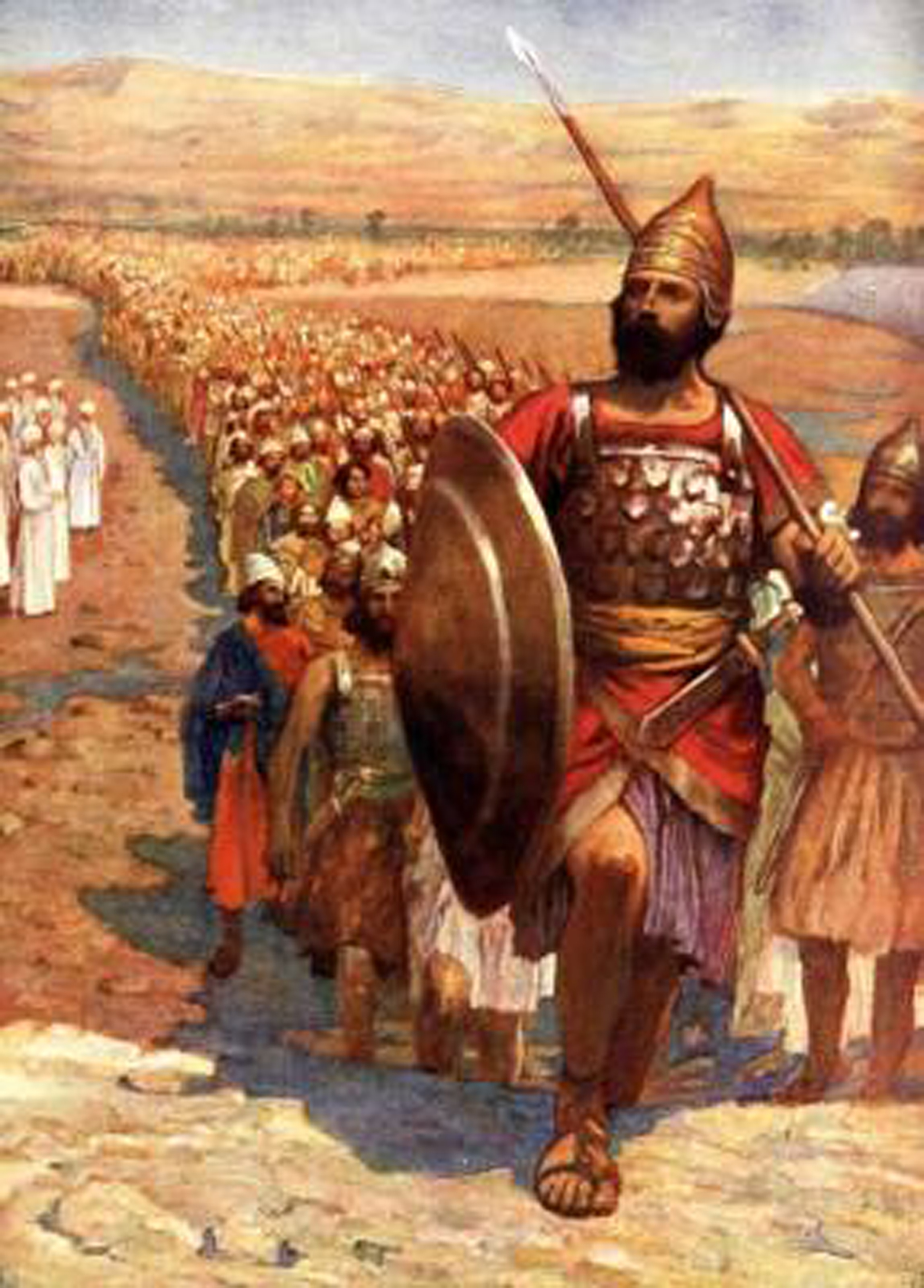 |
| Joshua Leads |
Samuel is a leader of ancient Israel in the Books of Samuel in the Hebrew Bible. He is also known as a prophet by Christians and Muslims, and is mentioned in the second chapter of the Qur'an, although not by name.
His status, as viewed by rabbinical literature, is that he was the last of the Hebrew Judges and the first of the major prophets who began to prophesy inside the Land of Israel. He was thus at the cusp between two eras. According to the text of the Books of Samuel, he also anointed the first two kings of the Kingdom of Israel: Saul and David.
** Calling
 |
| Eli and Samuel |
> One night, Samuel heard a voice calling his name. According to the Jewish historian Josephus, Samuel was about 12 years old. He initially assumed it was coming from Eli and went to Eli to ask what he wanted. Eli, however, sent Samuel back to sleep. After this happened three times Eli realized that the voice was the Lord's, and instructed Samuel on how to answer. Once Samuel responded, the Lord told him that the wickedness of the sons of Eli had resulted in their dynasty being condemned to destruction. In the morning, Eli asked Samuel to honestly recount to him what he had been told by the Lord. Upon receiving the communication, Eli merely said that the Lord should do what seems right unto him.

THE VULGATE BIBLE
The Vulgate is a late fourth-century Latin translation of the Bible that became, during the 16th century, the Catholic Church's officially promulgatedLatin version of the Bible.
The translation was largely the work of St. Jerome, who, in 382 AD, was commissioned by Pope Damasus I to revise the Vetus Latina ("Old Latin") collection of biblical texts in Latin then in use by the Church. Once published, it was widely adopted and eventually eclipsed the Vetus Latina and, by the 13th century, was known as the "versio vulgata" (the "version commonly-used") or, more simply, in Latin as vulgata or in Greek as βουλγάτα ("Vulgate").
The Catholic Church affirmed it as its official Latin Bible at the Council of Trent (1545–63 AD).
The translation was largely the work of St. Jerome, who, in 382 AD, was commissioned by Pope Damasus I to revise the Vetus Latina ("Old Latin") collection of biblical texts in Latin then in use by the Church. Once published, it was widely adopted and eventually eclipsed the Vetus Latina and, by the 13th century, was known as the "versio vulgata" (the "version commonly-used") or, more simply, in Latin as vulgata or in Greek as βουλγάτα ("Vulgate").
The Catholic Church affirmed it as its official Latin Bible at the Council of Trent (1545–63 AD).
KING JAMES BIBLE
 The King James Version (KJV), also known as the Authorized Version (AV) or the King James Bible (KJB), is an English translation of the Christian Bible for the Church of England begun in 1604 and completed in 1611. The books of the King James Version include the 39 books of the Old Testament, an intertestamental section containing 14 books of the Apocrypha, and the 27 books of the New Testament.
 It was first printed by the King's Printer Robert Barker and was the third translation into English, approved by the English Church authorities. The first had been the Great Bible, commissioned in the reign of King Henry VIII (1535), and the second had been the Bishops' Bible of 1568. In January 1604, James VI and I convened the Hampton Court Conference, where a new English version was conceived in response to the problems of the earlier translations perceived by the Puritans, a faction of the Church of England. The translation is noted for its "majesty of style", and has been described as one of the most important books in English culture.
LORD'S PRAYER
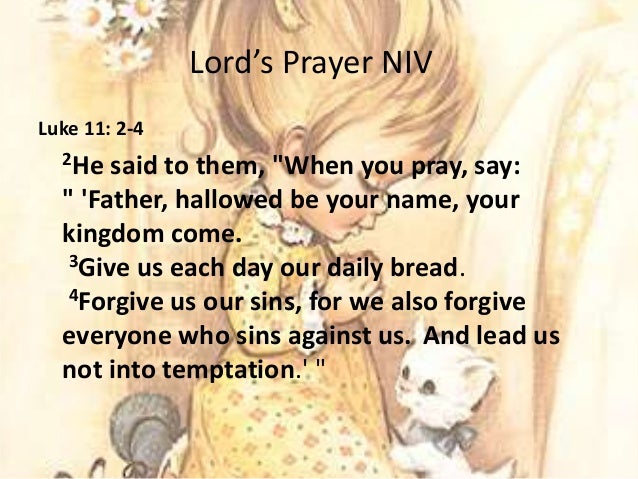
The Lord's Prayer (also called the Our Father or Pater Noster among other names) is a venerated Christian prayer that, according to the New Testament, was taught by Jesus to his disciples. Two versions of it are recorded: a longer form in the Gospel of Matthew as part of the Sermon on the Mount, and a shorter form in the Gospel of Luke as a response by Jesus to a request by "one of his disciples" to teach them "to pray as John taught his disciples." The context of the prayer in Matthew is a discourse deploring people who pray ostentatiously.
The original text of the prayer (in Greek) uniquely contains the word epiousios, which does not appear in any other extant classical or Koine Greek literature, and is also the only adjective in the prayer. The most common English language translation of this word is "daily". The prayer concludes with "deliver us from evil" in Matthew, and with "lead us not into temptation" in Luke. The first three of the seven petitions in Matthew address God; the other four are related to human needs and concerns. The liturgical form is the Matthean. Some Christians, particularly Protestants, conclude the prayer with a doxology, a later addendum appearing in some manuscripts of Matthew.
 |
| Matthew 6:9–13 (NRSV) |
 |
| Luke 11:2–4 (NRSV) |

No comments:
Post a Comment