GARDEN OF EDEN
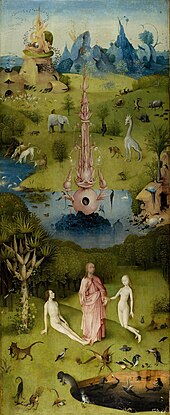 |
The Garden of Eden or often Paradise is the biblical "garden of God", described most notably in the Book of Genesis chapters 2 and 3, and also in the Book of Ezekiel. The "garden of God", not called Eden, is mentioned in Genesis 13, and the "trees of the garden" are mentioned in Ezekiel 31. The Book of Zechariah and the Book of Psalms also refer to trees and water in relation to the temple without explicitly mentioning Eden.
Traditionally, the favored derivation of the name "Eden" was from the Akkadian edinnu, derived from a Sumerian word meaning "plain" or "steppe". Eden is now believed to be more closely related to an Aramaic root word meaning "fruitful, well-watered." The Hebrew term is translated "pleasure" in Sarah's secret saying in Genesis 18:9-15.
Much like records of the great flood, creation story and confusion of languages, the story of Eden echoes the Mesopotamian myth of a king, as a primordial man, who is placed in a divine garden to guard the tree of life. In the Hebrew Bible, Adam and Eve are depicted as walking around the Garden of Eden naked due to their innocence.Eden and its rivers may signify the real Jerusalem, the Temple of Solomon, or the Promised Land. It may also represent the divine garden on Zion, and the mountain of God, which was also Jerusalem. The imagery of the Garden, with its serpent and cherubs, has been compared to the images of the Solomonic Temple with its copper serpent (the nehushtan) and guardian cherubs.
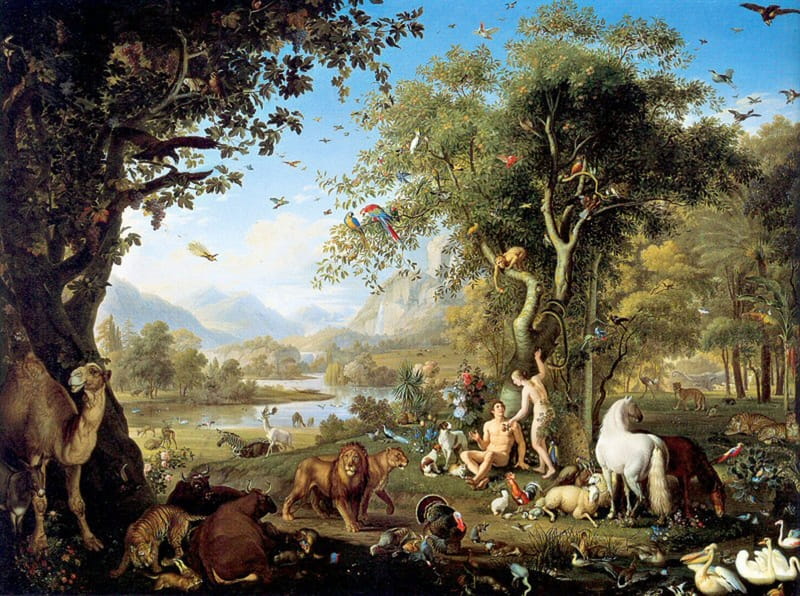 |
| Adam and Eve in The Garden Of Eden |
*CLOSE UP*
ORIGINAL SIN
LEDA
Gaius Julius Caesar (13 July 100 BC[1] – 15 March 44 BC),known as Julius Caesar, was a Roman politician, general, and notable author of Latin prose. He played a critical role in the events that led to the demise of the Roman Republic and the rise of the Roman Empire.
In 60 BC, Caesar, Crassus, and Pompey formed a political alliance that dominated Roman politics for several years. Their attempts to amass power as Populares were opposed by the Optimates within the Roman Senate, among them Cato the Younger with the frequent support of Cicero. Caesar's victories in the Gallic Wars, completed by 51 BC, extended Rome's territory to the English Channel and the Rhine. Caesar became the first Roman general to cross both when he built a bridge across the Rhine and conducted the first invasion of Britain.

 | ||||||||||||
ORIGINAL SIN
Original sin, also called ancestral sin, is the Christian doctrine of humanity's state of sin resulting from the fall of man, stemming from Adam and Eve's rebellion in Eden, namely the sin of disobedience in consuming from the tree of knowledge of good and evil.
The concept of original sin was first alluded to in the 2nd century by Irenaeus, Bishop of Lyon in his controversy with certain dualistGnostics. Other church fathers such as Augustine also developed the doctrine,[2] seeing it as based on the New Testament teaching of Paul the Apostle (Romans5:12–21 and 1 Corinthians15:22) and the Old Testament verse of Psalms51:5. Tertullian, Cyprian, Ambrose and Ambrosiaster considered that humanity shares in Adam's sin, transmitted by human generation. Augustine's formulation of original sin was popular among Protestant reformers, such as Martin Luther and John Calvin, who equated original sin with concupiscence, affirming that it persisted even after baptism and completely destroyed freedom. The Jansenist movement, which the Catholic Church declared to be heretical, also maintained that original sin destroyed freedom of will.
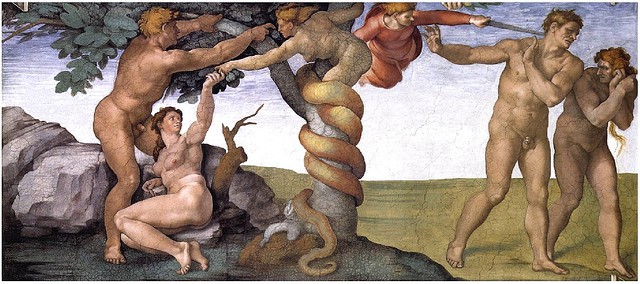 |
| Original Sin |
The story of the Garden of Eden and the Fall of Man represents a tradition among the Abrahamic peoples, with a presentation more or less symbolical of certain moral and religious truths.
GREEK GODS IN ATHENS
 |
| Two Greek Gods in Athens |
*RIGHT*
 |
| Apollo |
*LEFT*
 |
| Athena |
~HUBRIS
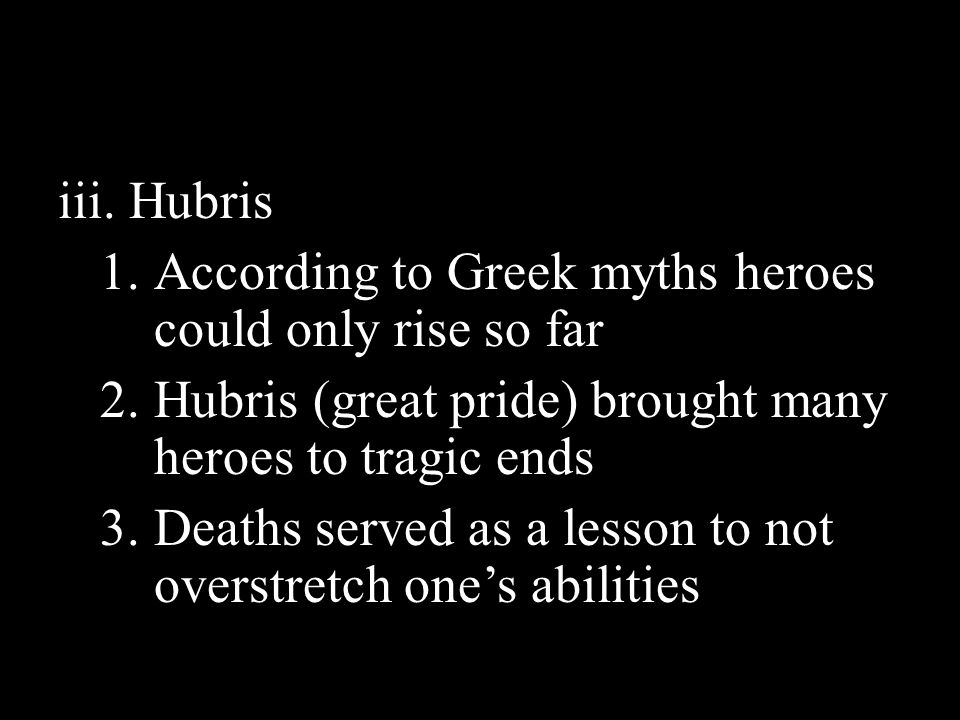
Hubris describes a personality quality of extreme or foolish pride or dangerous over-confidence.In its ancient Greek context, it typically describes behavior that defies the norms of behavior or challenges the gods, and which in turn brings about the downfall, or nemesis, of the perpetrator of hubris.
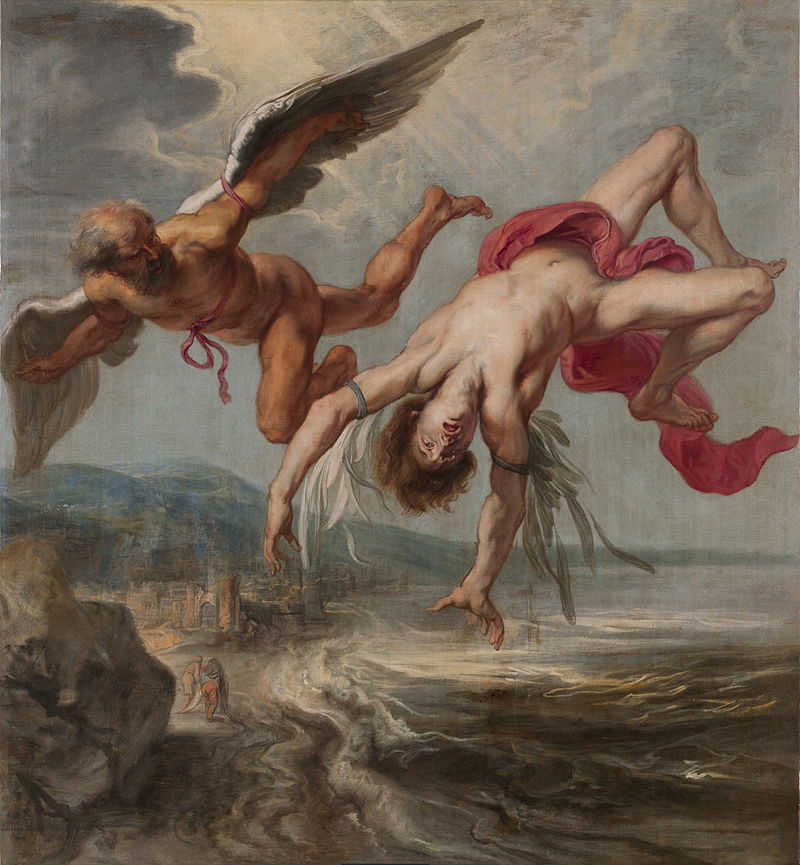 |
| The downfall of Icarus is attributed to his hubris. |
Hubris is often a characteristic of a person enjoys a powerful position;
he loses touch with reality due to this excessive power and starts to
overestimate his power, abilities, and accomplishments. Gradually, this
character crosses ordinary limits and violates moral ethics. This
behavior ultimately results in his downfall as well. Hubris can be found
in some of the major characters in tragedies.
 |
~PRIDE
Pride is an inwardly directed emotion that carries two antithetical meanings. With a negative connotation pride refers to a foolishly and irrationally corrupt sense of one's personal value, status or accomplishments, used synonymously with hubris. With a negative connotation, pride refers to a humble and content sense of attachment toward one's own or another's choices and actions, or toward a whole group of people, and is a product of praise, independent self-reflection, and a fulfilled feeling of belonging.
One definition of pride in the former sense comes from St. Augustine: "the love of one's own excellence". A similar definition comes from Meher Baba: "Pride is the specific feeling through which egoism manifests."
Pride is sometimes viewed as corrupt or as a vice, sometimes as proper or as a virtue. While some philosophers such as Aristotle (and George Bernard Shaw) consider pride (but not hubris) a profound virtue, some world religions consider pride's fraudulent form a sin, such as is expressed in Proverbs 11:2 of the Old Testament.
One definition of pride in the former sense comes from St. Augustine: "the love of one's own excellence". A similar definition comes from Meher Baba: "Pride is the specific feeling through which egoism manifests."
Pride is sometimes viewed as corrupt or as a vice, sometimes as proper or as a virtue. While some philosophers such as Aristotle (and George Bernard Shaw) consider pride (but not hubris) a profound virtue, some world religions consider pride's fraudulent form a sin, such as is expressed in Proverbs 11:2 of the Old Testament.
 | |
LEDA
 |
| Leda On The Nidd |
In Greek mythology, Leda was daughter of the Aetolian king Thestius, and wife of king Tyndareus (Τυνδάρεως) of Sparta. Her myth gave rise to the popular motif in Renaissance and later art of Leda and the Swan. She was the mother of Helen of Troy, Clytemnestra , and Castor and Pollux.
Leda was admired by Zeus, who seduced her in the guise of a swan. As a swan, Zeus fell into her arms for protection from a pursuing eagle. Their consummation, on the same night as Leda lay with her husband Tyndareus, resulted in two eggs from which hatched Helen (later known as the beautiful "Helen of Troy"), Clytemnestra, and Castor and Pollux (also known as the Dioscuri ). Which children are the progeny of Tyndareus the mortal king, and which are of Zeus and thus half-immortal, is not consistent among accounts, nor is which child hatched from which egg. The split is almost always half mortal, half divine, although the pairings do not always reflect the children's heritage pairings. Castor and Pollux are sometimes both mortal, sometimes both divine. One consistent point is that if only one of them is immortal, it is Pollux. It is also always stated that Helen is the daughter of Zeus.
Leda also had other daughters by Tyndareus: Timandra, Phoebe, and Philonoe
Leda was admired by Zeus, who seduced her in the guise of a swan. As a swan, Zeus fell into her arms for protection from a pursuing eagle. Their consummation, on the same night as Leda lay with her husband Tyndareus, resulted in two eggs from which hatched Helen (later known as the beautiful "Helen of Troy"), Clytemnestra, and Castor and Pollux (also known as the Dioscuri ). Which children are the progeny of Tyndareus the mortal king, and which are of Zeus and thus half-immortal, is not consistent among accounts, nor is which child hatched from which egg. The split is almost always half mortal, half divine, although the pairings do not always reflect the children's heritage pairings. Castor and Pollux are sometimes both mortal, sometimes both divine. One consistent point is that if only one of them is immortal, it is Pollux. It is also always stated that Helen is the daughter of Zeus.
Leda also had other daughters by Tyndareus: Timandra, Phoebe, and Philonoe

PERSEPHONE
In Greek mythology, Persephone, also called Kore ("the maiden") or Cora, is the daughter of Zeus and the harvest goddess Demeter, and is the queen of the underworld. Homer describes her as the formidable, venerable majestic princess of the underworld, who carries into effect the curses of men upon the souls of the dead. Persephone was married to Hades, the god-king of the underworld. The myth of her abduction represents her function as the personification of vegetation, which shoots forth in spring and withdraws into the earth after harvest; hence, she is also associated with spring as well as the fertility of vegetation.
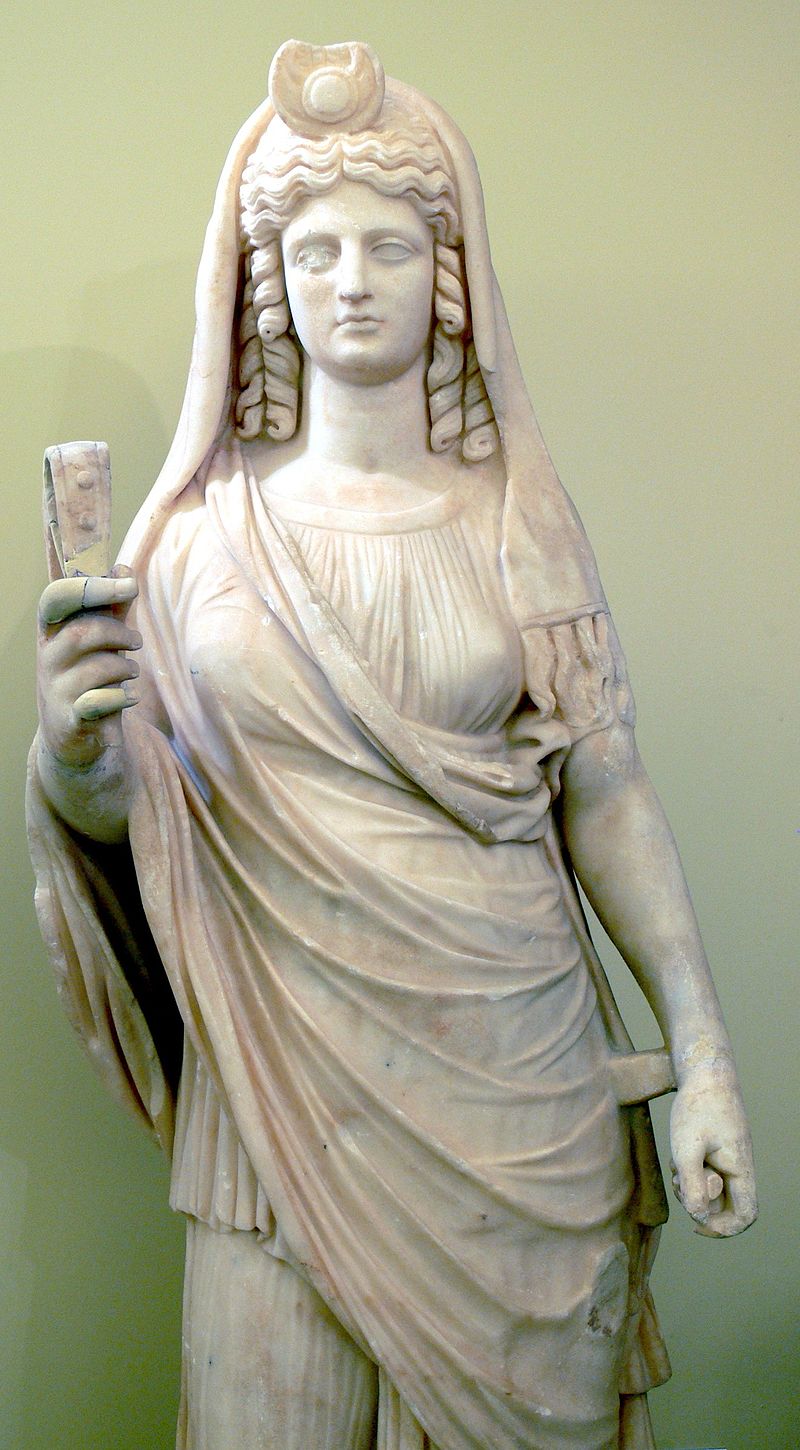 |
| Goddess of The Underworld, Spring time, Flowers, Vegetation |
ANDROMACHE
 |
| A Farewell of Hector to Andromache and Astyanax |
In Greek mythology, Andromache was the wife of Hector, daughter of Eetion, and sister to Podes. She was born and raised in the city of Cilician Thebe, over which her father ruled. The name means "man battler" or "fighter of men" or "man's battle" (i.e. "courage" or "manly virtue").
During the Trojan War, after Hector was killed by Achilles and the city taken by the Greeks, the Greek herald Talthybius informed her of the plan to kill Astyanax, her son by Hector, by throwing him from the city walls. This act was carried out by Neoptolemus who then took Andromache as a concubine and Hector's brother, Helenus, as a slave. By Neoptolemus, she was the mother of Molossus, and according to Pausanias, of Pielus and Pergamus. When Neoptolemus died, Andromache married Helenus and became Queen of Epirus. Pausanias also implies that Helenus' son, Cestrinus, was by Andromache. Andromache eventually went to live with Pergamus in Pergamum, where she died of old age.
JULIUS CAESAR
Gaius Julius Caesar (13 July 100 BC[1] – 15 March 44 BC),known as Julius Caesar, was a Roman politician, general, and notable author of Latin prose. He played a critical role in the events that led to the demise of the Roman Republic and the rise of the Roman Empire.
In 60 BC, Caesar, Crassus, and Pompey formed a political alliance that dominated Roman politics for several years. Their attempts to amass power as Populares were opposed by the Optimates within the Roman Senate, among them Cato the Younger with the frequent support of Cicero. Caesar's victories in the Gallic Wars, completed by 51 BC, extended Rome's territory to the English Channel and the Rhine. Caesar became the first Roman general to cross both when he built a bridge across the Rhine and conducted the first invasion of Britain.
 |
*CLOSE UP*
 |
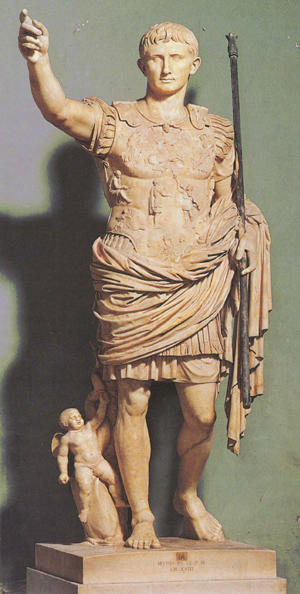 |
| The statue known as the Augustus of Prima Porta, 1st century |
OCTAVIAN AUGUSTUS
Augustus (23 September 63 BC – 19 August 14 AD) was the founder of the Roman Principate and considered the first Emperor, controlling the Roman Empire from 27 BC until his death in AD 14.
He was born Gaius Octavius into an old and wealthy equestrian branch of the plebeianOctavii family. His maternal great-uncle Julius Caesar was assassinated in 44 BC, and Octavius was named in Caesar's will as his adopted son and heir, then known as Octavianus (Anglicized as Octavian). He, Mark Antony, and Marcus Lepidus formed the Second Triumvirate to defeat the assassins of Caesar. Following their victory at Philippi, the Triumvirate divided the Roman Republic among themselves and ruled as military dictators.[note 4] The Triumvirate was eventually torn apart by the competing ambitions of its members. Lepidus was driven into exile and stripped of his position, and Antony committed suicide following his defeat at the Battle of Actium by Octavian in 31 BC.
He was born Gaius Octavius into an old and wealthy equestrian branch of the plebeianOctavii family. His maternal great-uncle Julius Caesar was assassinated in 44 BC, and Octavius was named in Caesar's will as his adopted son and heir, then known as Octavianus (Anglicized as Octavian). He, Mark Antony, and Marcus Lepidus formed the Second Triumvirate to defeat the assassins of Caesar. Following their victory at Philippi, the Triumvirate divided the Roman Republic among themselves and ruled as military dictators.[note 4] The Triumvirate was eventually torn apart by the competing ambitions of its members. Lepidus was driven into exile and stripped of his position, and Antony committed suicide following his defeat at the Battle of Actium by Octavian in 31 BC.
*CLOSE UP*
EXTRA INFORMATION
~SISTINE CHAPEL CEILING
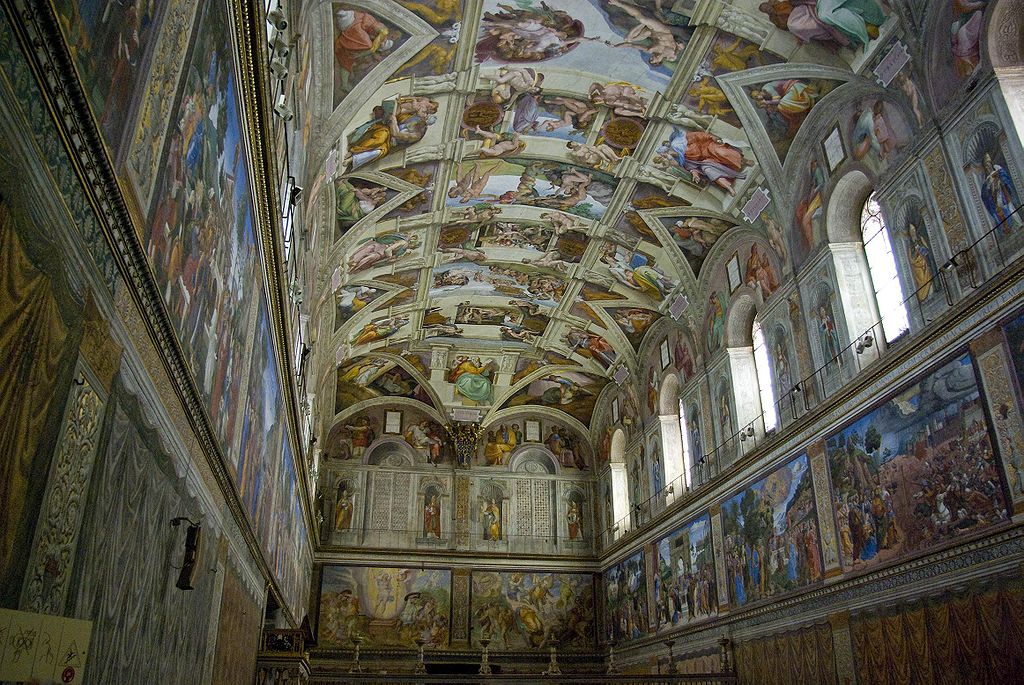
The Sistine Chapel ceiling, painted by Michelangelo between 1508 and 1512, is a cornerstone work of High Renaissance art. The ceiling is that of the Sistine Chapel, the large papal chapel built within the Vatican between 1477 and 1480 by Pope Sixtus IV, for whom the chapel is named. It was painted at the commission of Pope Julius II. The chapel is the location for papal conclaves and many important services. The ceiling's various painted elements form part of a larger scheme of decoration within the Chapel, which includes the large fresco The Last Judgment on the sanctuary wall, also by Michelangelo, wall paintings by several leading painters of the late 15th century including Sandro Botticelli, Domenico Ghirlandaio and Pietro Perugino, and a set of large tapestries by Raphael, the whole illustrating much of the doctrine of the Catholic Church.
Central to the ceiling decoration are nine scenes from the Book of Genesis of which The Creation of Adam is the best known, having an iconic standing equalled only by Leonardo da Vinci's Mona Lisa, the hands of God and Adam being reproduced in countless imitations. The complex design includes several sets of individual figures, both clothed and nude, which allowed Michelangelo to fully demonstrate his skill in creating a huge variety of poses for the human figure and which have provided an enormously influential pattern book of models for other artists ever since.
Central to the ceiling decoration are nine scenes from the Book of Genesis of which The Creation of Adam is the best known, having an iconic standing equalled only by Leonardo da Vinci's Mona Lisa, the hands of God and Adam being reproduced in countless imitations. The complex design includes several sets of individual figures, both clothed and nude, which allowed Michelangelo to fully demonstrate his skill in creating a huge variety of poses for the human figure and which have provided an enormously influential pattern book of models for other artists ever since.
 |
| The Creation of Adam |
~ADAM'S APPLE
The Adam's apple, or laryngeal prominence is a feature of the human neck, and is the lump or protrusion that is formed by the angle of the thyroid cartilage surrounding the larynx.The Adam's apple, in conjunction with the thyroid cartilage which forms it, helps to protect the walls and the frontal part of the larynx, including the vocal cords(which are located directly behind it). It is found in both women and men.
Another function of the Adam's apple is related to the deepening of the voice. During adolescence, the thyroid cartilage grows together with the larynx. Consequently, the laryngeal prominence grows in size mainly in men. Together, a larger soundboard is made up in phonation apparatus and, as a result, the man gets a deeper voice note.
Another function of the Adam's apple is related to the deepening of the voice. During adolescence, the thyroid cartilage grows together with the larynx. Consequently, the laryngeal prominence grows in size mainly in men. Together, a larger soundboard is made up in phonation apparatus and, as a result, the man gets a deeper voice note.
 |
| Jimin BTS |
~FEMME FATALE
A femme fatale is a stock character of a mysterious and seductive woman whose charms ensnare her lovers, often leading them into compromising, dangerous, and deadly situations. She is an archetype of literature and art. Her ability to entrance and hypnotise her victim with a spell was in the earliest stories seen as being literally supernatural; hence, the femme fatale today is still often described as having a power akin to an enchantress, seductress, vampire, witch, or demon, having power over men. In American early 20th century film, femme fatale characters were referred to as vamps, an allusion to their role as sexual vampires.
The phrase is French for "fatal woman". A femme fatale tries to achieve her hidden purpose by using feminine wiles such as beauty, charm, and sexual allure. In some situations, she uses lies or coercion rather than charm. She may also make use of some subduing weapon such as sleeping gas, a modern analog of magical powers in older tales. She may also be (or imply that she is) a victim, caught in a situation from which she cannot escape; The Lady from Shanghai (a 1947 film noir) is one such example.
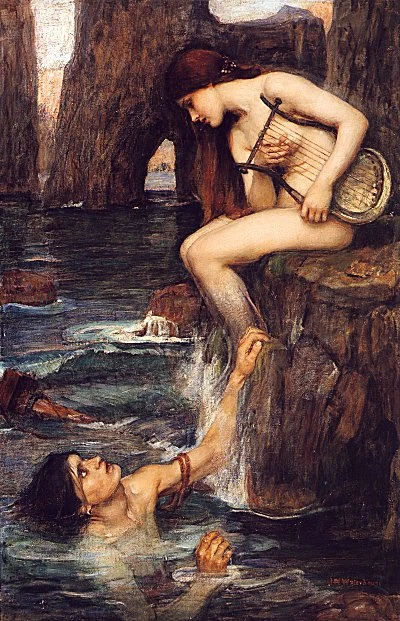 |
| Femme Fatale (Mythology Wiki) |
** PREFIX, ROOT, SUFFIX **
be : thoroughly, completely; cause seem; to provide with; at, on, to, for
beside : by the side
beside : by the side
befriend : to become a friend to someone
beloved : dearly love
fa : brittle, shattered
fragile : easily broken or damage
fraction : a small part of something
fracture : the result of breaking something
ab : off, away from
abandon : to leave and never return
abrade : to damage something by rubbing, grinding, or scraping

No comments:
Post a Comment