OEDIPUS REX
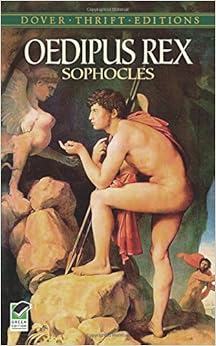
Oedipus Rex, also known by its Greek title, Oedipus Tyrannus, or Oedipus the King, is an Athenian tragedy by Sophocles that was first performed around 429 BC. Originally, to the ancient Greeks, the title was simply Oedipus, as it is referred to by Aristotle in the Poetics. It is thought to have been renamed Oedipus Tyrannus to distinguish it from Oedipus at Colonus. In antiquity, the term “tyrant” referred to a ruler, but it did not necessarily have a negative connotation.
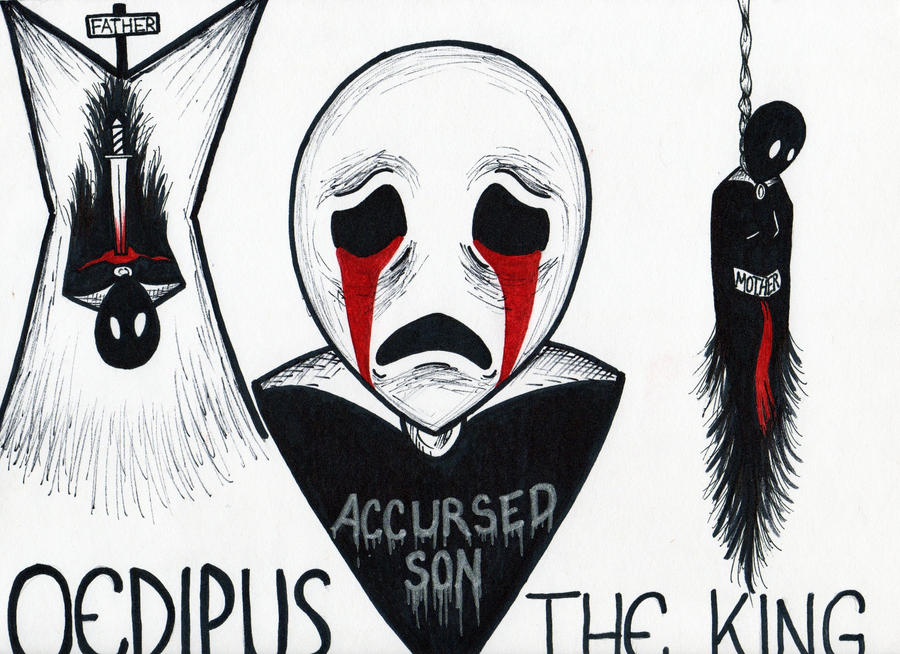
Prior to the start of Oedipus Rex, Oedipus has become the king of Thebes while unwittingly fulfilling a prophecy that he would kill his father, Laius (the previous king), and marry his mother, Jocasta (whom Oedipus took as his queen after solving the riddle of the Sphinx). The action of Sophocles' play concerns Oedipus' search for the murderer of Laius in order to end a plague ravaging Thebes, unaware that the killer he is looking for is none other than himself. At the end of the play, after the truth finally comes to light, Jocasta hangs herself while Oedipus, horrified at his patricide and incest, proceeds to gouge out his own eyes in despair.
 |
| Sophocles |
Sophocles (c. 497/6 – winter 406/5 BC) is one of three ancient Greek tragedians whose plays have survived. His first plays were written later than those of Aeschylus, and earlier than or contemporary with those of Euripides. Sophocles wrote 120 plays during the course of his life, but only seven have survived in a complete form: Ajax, Antigone, The Women of Trachis, Oedipus the King, Electra, Philoctetes and Oedipus at Colonus.
The most famous tragedies of Sophocles feature Oedipus and also Antigone: they are generally known as the Theban plays, although each play was actually a part of a different tetralogy, the other members of which are now lost. Sophocles influenced the development of the drama, most importantly by adding a third actor, thereby reducing the importance of the chorus in the presentation of the plot. He also developed his characters to a greater extent than earlier playwrights such as Aeschylus.
*CLOSE UP*
 |
 |
ELECTRA
 |
| Electra |
In Greek mythology, Electra was the daughter of King Agamemnon and Queen Clytemnestra, and thus princess of Argos. She and her brother Orestes plotted revenge against their mother Clytemnestra and stepfather Aegisthus for the murder of their father, Agamemnon.
Electra is one of the most popular mythological characters in tragedies.She is the main character in two Greek tragedies, Electra by Sophocles and Electra by Euripides. She is also the central figure in plays by Aeschylus, Alfieri, Voltaire, Hofmannsthal, and Eugene O'Neill.
In psychology, the Electra complex is named after her.
 |
| Electra and her Brother Orestes |
>> ELECTRA COMPLEX
"Daddy's girl" and "Daddy's little girl" redirect here. For other uses, see Daddy's Girl (disambiguation) and Daddy's Little Girl (disambiguation).
In Neo-Freudian psychology, the Electra complex, as proposed by Carl Gustav Jung, is a girl's psychosexual competition with her mother for possession of her father. In the course of her psychosexual development, the complex is the girl's phallic stage; formation of a discrete sexual identity, a boy's analogous experience is the Oedipus complex. The Electra complex occurs in the third—phallic stage (ages 3–6)—of five psychosexual development stages: (i) the Oral, (ii) the Anal, (iii) the Phallic, (iv) the Latent, and (v) the Genital—in which the source libido pleasure is in a different erogenous zone of the infant’s body.
In classical psychoanalytic theory, the child's identification with the same-sex parent is the successful resolution of the Electra complex and of the Oedipus complex; his and her key psychological experience to developing a mature sexual role and identity. Sigmund Freud instead proposed that girls and boys resolved their complexes differently—she via penis envy, he via castration anxiety; and that unsuccessful resolutions might lead to neurosis and homosexuality.[citation needed] Hence, women and men who are fixated in the Electra and Oedipal stages of their psychosexual development might be considered "father-fixated" and "mother-fixated" as revealed when the mate (sexual partner) resembles the father or the mother.

CLYTEMNESTRA
 |
| Clytemnestra |
Clytemnestra was the wife of Agamemnon and queen of Mycenae (or sometimes Argos) in ancient Greek legend. In the Oresteia by Aeschylus, she murdered Agamemnon – said by Euripides to be her second husband – and the Trojan princess Cassandra, whom he had taken as war prize following the sack of Troy; however, in Homer's Odyssey, her role in Agamemnon's death is unclear and her character is significantly more subdued.
> Name :
Her Greek name Klytaimnḗstra is also sometimes latinized as Clytaemnestra. It is commonly glossed as "famed for her suitors". Aeschylus, in certain wordplays on her name, appears to assume an etymological link with the verb mḗdomai ("scheme, contrive").
> Background :
Clytemnestra was the daughter of Tyndareus and Leda, the King and Queen of Sparta. According to the myth, Zeus appeared to Leda in the form of a swan, seducing and impregnating her. Leda produced four offspring from two eggs: Castor and Clytemnestra from one egg, and Helen and Polydeuces (Pollux) from the other. Therefore, Castor and Clytemnestra were fathered by Tyndareus, whereas Helen and Polydeuces were fathered by Zeus.
THE SCHOOL OF ATHENS
The School of Athens (Italian: Scuola di Atene) is one of the most famous frescoes by the Italian Renaissance artist Raphael. It was painted between 1509 and 1511 as a part of Raphael's commission to decorate the rooms now known as the Stanze di Raffaello, in the Apostolic Palace in the Vatican. The Stanza della Segnatura was the first of the rooms to be decorated, and The School of Athens, representing Philosophy, was probably the second painting to be finished there, after La Disputa (Theology) on the opposite wall, and the Parnassus (Literature). The picture has long been seen as "Raphael's masterpiece and the perfect embodiment of the classical spirit of the Renaissance".
 | |||
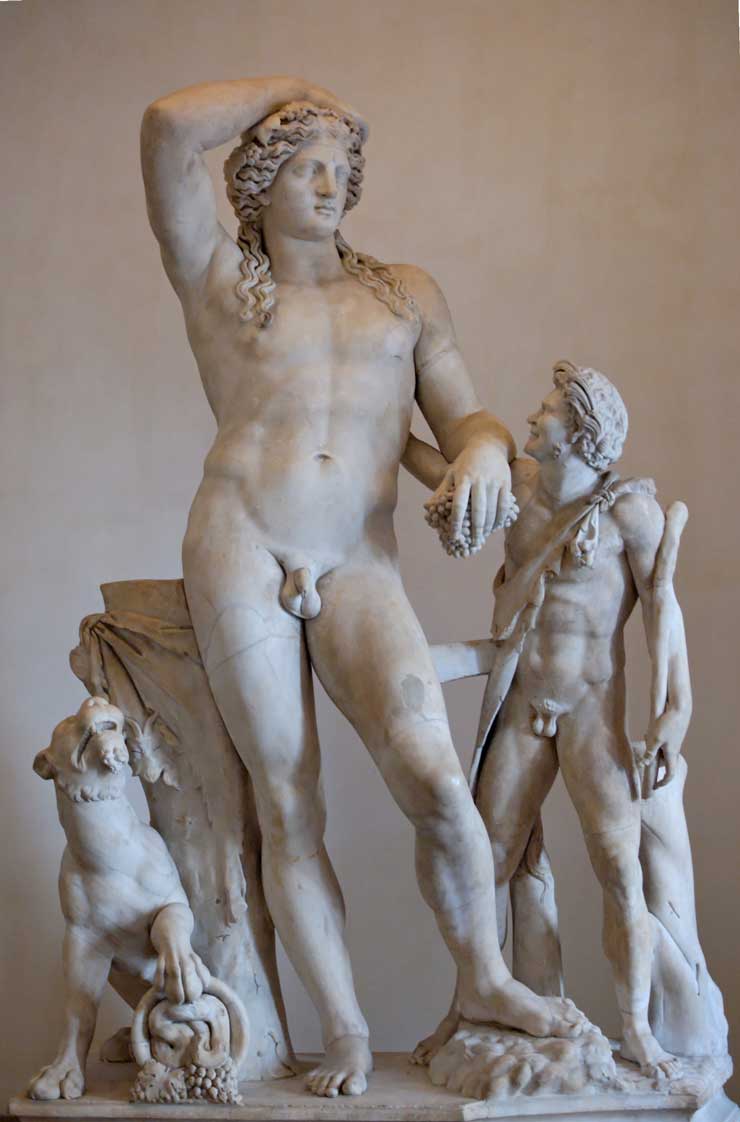 |
Dionysus is the god of the grape harvest, winemaking and wine, of ritual madness, fertility, theatre and religious ecstasy in ancient Greek religion and myth. Wine played an important role in Greek culture, and the cult of Dionysus was the main religious focus for its unrestrained consumption. He may have been worshipped as early as c. 1500–1100 BC by Mycenean Greeks; traces of Dionysian-type cult have also been found in ancient Minoan Crete. In some cults, he arrives from the east, as an Asiatic foreigner; in others, from Ethiopia in the South. He is a god of epiphany, "the god that comes", and his "foreignness" as an arriving outsider-god may be inherent and essential to his cults. He is a major, popular figure of Greek mythology and religion, becoming increasingly important over time, and included in some lists of the twelve Olympians, as the last of their number, and the only god born from a mortal mother. His festivals were the driving force behind the development of Greek theatre.
 |
| God of the vine, grape harvest, winemaking, wine, ritual madness, religious ecstasy, and theatre |
AEGISTHUS
Aegisthus is a figure in Greek mythology. He was the son of Thyestes and his daughter, Pelopia. The product of an incestuous union motivated by his father's rivalry with the house of Atreus for the throne of Mycenae, Aegisthus murdered Atreus to restore his father to power. Later, he lost the throne to Atreus's son Agamemnon.
While Agamemnon was at the Trojan war, Aegisthus became the lover of the king's estranged wife Clytemnestra. The couple killed Agamemnon on his return. He became king of Mycenae for seven years before he was killed in his turn by Agamemnon's son Orestes.
 | |
| Orestes slaying Aegisthus and Clytemnestra |
*** SPECIAL INFORMATION ***
Ancient Greece - A moment of Excellence
EXTRA INFORMATION
Quills is a 2000 American-British-German period film directed by Philip Kaufman and adapted from the Obie award-winning play by Doug Wright, who also wrote the original screenplay. Inspired by the life and work of the Marquis de Sade, Quills re-imagines the last years of the Marquis' incarceration in the insane asylum at Charenton.
Quills filmmakers and writers said they were not making a biography of de Sade, but exploring issues such as censorship, pornography, sex, art, mental illness, and religion. It was released with an R rating from the Motion Picture Association of America and an 18 rating from the British Board of Film Classification due to "strong horror, violence, sex, sexual violence, and nudity".

Quills begins in Paris during the Reign of Terror, with the incarcerated Marquis de Sade penning a story about the libidinous Mademoiselle Renard, a ravishing young aristocrat who meets the preeminent sadist in her executioner.
** Watch movie: http://putlockers.ch/watch-quills-online-free-putlocker.html

No comments:
Post a Comment