Week 1
ORIENTATION
What are Roman Numerals ?
Roman numerals are the counting symbols used by the ancient
Romans. They used only a few letters from the alphabet. We know these
letters as I, V, X, L, C, D, and M. Each letter stands for a certain
number. Roman number system is one of the ancient counting and calculating
methods. Used in the period between 9th century BC to 2nd century AD,
they served us with one of the most complicated methods to count,
especially when it comes to larger numbers. For now,
let me show you what numbers these letters stand for:
| I | V | X | L | C | D | M |
|---|---|---|---|---|---|---|
| 1 | 5 | 10 | 50 | 100 | 500 | 1000 |
Basic symbols to write Roman Numerals
The Roman Numeral system has basic letter symbols for the following numbers:1 = I, 5 = V, 10 = X, 50 = L, 100 = C, 500 = D and 1000 = M.
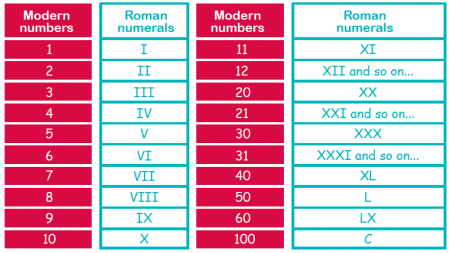
Yes that's all we have -- 7 basic letter symbols to represent 7
different numbers. All the other numbers can be formed using these seven
symbols. Seems kind of magical, doesn’t it? Well, let’s learn more to
see how it is possible.
Repetition Rules
-
Repetition of a Roman numeral means addition.
For example: X means 10, so XX will mean 20 and XXX will mean 30.
-
Only I, X, C and M can be repeated. V, L and D can never be repeated.
For example, V means 5, but we can not write VV to convey 10. It is against the rules!
-
No symbol can be repeated more than three times.
For example, we can not write XXXX to convey 40.
HOMEWORK
WATCH "HELEN OF TROY"

watch here:

No comments:
Post a Comment