HOMER's ITHACA
Ithaca was, in Greek mythology, the island home of the hero Odysseus. The specific location of the island, as it was described in Homer's Odyssey, is a matter for debate. There have been various theories about its location, although Modern Ithaca is generally accepted to be Homer's island by most scholars.
The central characters of the epic such as Odysseus, Achilles, Agamemnon and Hector are generally believed to be fictional characters. Yet there are many claims that some Homeric hero long ago had inhabited a particular contemporary region or village. This, and the extremely detailed geographic descriptions in the epic itself, have invited investigation of the possibility that Homer's heroes might have existed and that the location of the sites described therein might be found.
The central characters of the epic such as Odysseus, Achilles, Agamemnon and Hector are generally believed to be fictional characters. Yet there are many claims that some Homeric hero long ago had inhabited a particular contemporary region or village. This, and the extremely detailed geographic descriptions in the epic itself, have invited investigation of the possibility that Homer's heroes might have existed and that the location of the sites described therein might be found.
Theories on the location of "Homer's 'Ithaca'" were formulated as early as the 2nd century BC to as recently as AD 2003. Each approach to identifying a location has been different, varying in degrees of scientific procedure, empirical investigation, informed hypothesis, wishful thinking, fervent belief, and sheer fantasy. Each investigator and each investigation merits interest, as an indicator both of the temper of the times in which a particular theory was developed, and of the perennial interest in Odysseus and the possible facts of his life. Some of the latest "Homer's 'Ithaca'" approaches resemble some of the earliest.

*INSIDE*
 |
| Homer's Ithaca |
CATHARSIS
Catharsis (from Greek κάθαρσις katharsis meaning "purification" or "cleansing") is the purification and purgation of emotions—especially pity and fear—through art or any extreme change in emotion that results in renewal and restoration. It is a metaphor originally used by Aristotle in the Poetics, comparing the effects of tragedy on the mind of a spectator to the effect of a cathartic on the body.
 |
| Aristotle |
Catharsis is a term in dramatic art that describes the effect of tragedy (or comedy and quite possibly other artistic forms) principally on the audience (although some have speculated on characters in the drama as well). Nowhere does Aristotle explain the meaning of "catharsis" as he is using that term in the definition of tragedy in the Poetics (1449b21-28). G. F. Else argues that traditional, widely held interpretations of catharsis as "purification" or "purgation" have no basis in the text of the Poetics, but are derived from the use of catharsis in other Aristotelian and non-Aristotelian contexts. For this reason, a number of diverse interpretations of the meaning of this term have arisen. The term is often discussed along with Aristotle's concept of anagnorisis.
>> Poetics ( Aristotle )
Aristotle's Poetics (c. 335 BCE) is the earliest surviving work of dramatic theory and the first extant philosophical treatise to focus on literary theory.

Aristotle offers an account of what he calls "poetry" (a term which in Greek literally means "making" and in this context includes drama – comedy, tragedy, and the satyr play – as well as lyric poetry and epic poetry). They are similar in the fact that they are all imitations but different in the three ways that Aristotle describes:
- Differences in music rhythm, harmony, meter and melody.
- Difference of goodness in the characters.
- Difference in how the narrative is presented: telling a story or acting it out.
*CLOSE UP*

MIMESIS
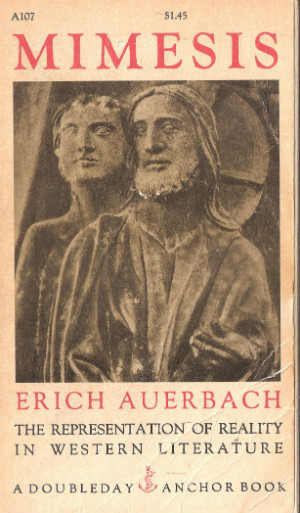 Mimesis ( "to imitate," from μῖμος (mimos), "imitator, actor") is a critical and philosophical term that carries a wide range of meanings, which include imitation, representation, mimicry, imitatio, receptivity, nonsensuous similarity, the act of resembling, the act of expression, and the presentation of the self.
 In ancient Greece, mimesis was an idea that governed the creation of works of art, in particular, with correspondence to the physical world understood as a model for beauty, truth, and the good. Plato contrasted mimesis, or imitation, with diegesis, or narrative. After Plato, the meaning of mimesis eventually shifted toward a specifically literary function in ancient Greek society, and its use has changed and been reinterpreted many times since then.
One of the best-known modern studies of mimesis, understood as a form of realism in literature, is Erich Auerbach's Mimesis: The Representation of Reality in Western Literature, which opens with a famous comparison between the way the world is represented in Homer's Odyssey and the way it appears in the Bible. From these two seminal Western texts, Auerbach builds the foundation for a unified theory of representation that spans the entire history of Western literature, including the Modernist novels being written at the time Auerbach began his study. In art history, "mimesis", "realism" and "naturalism" are used, often interchangeably, as terms for the accurate, even "illusionistic", representation of the visual appearance of things.

EXTRA INFORMATION
~INRI (Jesus, King of the Jews)
In the New Testament, Jesus is referred to as the King of the Jews, both at the beginning of his life and at the end. In the Koine Greek of the New Testament, e.g. in John 19:3, this is written Basileus ton Ioudaion.
Both uses of the title lead to dramatic results in the New Testament accounts. In the account of the Nativity of Jesus in the Gospel of Matthew, the wise men (i.e. Magi) who come from the east call Jesus the "King of the Judeans", causing King Herod to order the Massacre of the Innocents. Towards the end of the accounts of all four Canonical Gospels, in the narrative of the Passion of Jesus, the use of the "King of the Judeans" title leads to charges against Jesus that result in his Crucifixion.
The initialism INRI represents the Latin inscription which in English reads as "Jesus the Nazarene, King of the Jews" and John 19:20 states that this was written in three languages — Aramaic, Latin, and Greek — during the crucifixion of Jesus. The Greek version of the initialism read ΙΝΒΙ, representing Ἰησοῦς ὁ Ναζωραῖος ὁ Bασιλεὺς τῶν Ἰουδαίων which is best translated, "Jesus the Nazorean, King of the Judeans."
In the New Testament, the "King of the Jews” title is used only by the gentiles, namely by the Magi, Pontius Pilate, and the Roman soldiers. In contrast, the Jewish leaders use the designation "King of Israel". The phrase has also been translated King of the Judeans.
** PREFIX, ROOT, SUFFIX **
-gon : size, angle
pentagon : a flat shape that has five sides and five corners
trigonometry : branch of math that deals with relation between sides and angles of triangels
hexagon : six-cornered, hexagonal
-meter : measure
thermometer : an instrument user for measuring temperature
barometer : an instrument user for measuring air pressure
anemometer : an instrument for measuring the force or speed and direction of the wind
tri- : three, having three, once every three
triplicate : triple, three fold
triceps : three-headed
tricuspid : three-pointed
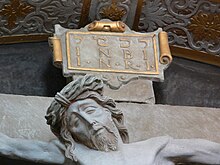 |
| The acronym INRI written in three language |
Both uses of the title lead to dramatic results in the New Testament accounts. In the account of the Nativity of Jesus in the Gospel of Matthew, the wise men (i.e. Magi) who come from the east call Jesus the "King of the Judeans", causing King Herod to order the Massacre of the Innocents. Towards the end of the accounts of all four Canonical Gospels, in the narrative of the Passion of Jesus, the use of the "King of the Judeans" title leads to charges against Jesus that result in his Crucifixion.
The initialism INRI represents the Latin inscription which in English reads as "Jesus the Nazarene, King of the Jews" and John 19:20 states that this was written in three languages — Aramaic, Latin, and Greek — during the crucifixion of Jesus. The Greek version of the initialism read ΙΝΒΙ, representing Ἰησοῦς ὁ Ναζωραῖος ὁ Bασιλεὺς τῶν Ἰουδαίων which is best translated, "Jesus the Nazorean, King of the Judeans."
In the New Testament, the "King of the Jews” title is used only by the gentiles, namely by the Magi, Pontius Pilate, and the Roman soldiers. In contrast, the Jewish leaders use the designation "King of Israel". The phrase has also been translated King of the Judeans.
** PREFIX, ROOT, SUFFIX **
-gon : size, angle
pentagon : a flat shape that has five sides and five corners
trigonometry : branch of math that deals with relation between sides and angles of triangels
hexagon : six-cornered, hexagonal
-meter : measure
thermometer : an instrument user for measuring temperature
barometer : an instrument user for measuring air pressure
anemometer : an instrument for measuring the force or speed and direction of the wind
tri- : three, having three, once every three
triplicate : triple, three fold
triceps : three-headed
tricuspid : three-pointed

No comments:
Post a Comment