 Week 17
DRAMA
Drama is the specific mode of fiction represented in performance. The term comes from a Greek word meaning "action", which is derived from "to do". The two masks associated with drama represent the traditional generic division between comedy and tragedy. They are symbols of the ancient Greek Muses, Thalia, and Melpomene.
Thalia was the Muse of comedy (the laughing face), while Melpomene was
the Muse of tragedy (the weeping face). Considered as a genre of poetry in general, the dramatic mode has been contrasted with the epic and the lyrical modes ever since Aristotle's Poetics (c. 335 BCE)—the earliest work of dramatic theory.
Drama is often combined with music and dance: the drama in opera is generally sung throughout; musicals generally include both spoken dialogue and songs; and some forms of drama have incidental music or musical accompaniment underscoring the dialogue (melodrama and Japanese Nō, for example). Closet drama describes a form that is intended to be read, rather than performed. In improvisation, the drama does not pre-exist the moment of performance; performers devise a dramatic script spontaneously before an audience.
TRAGEDY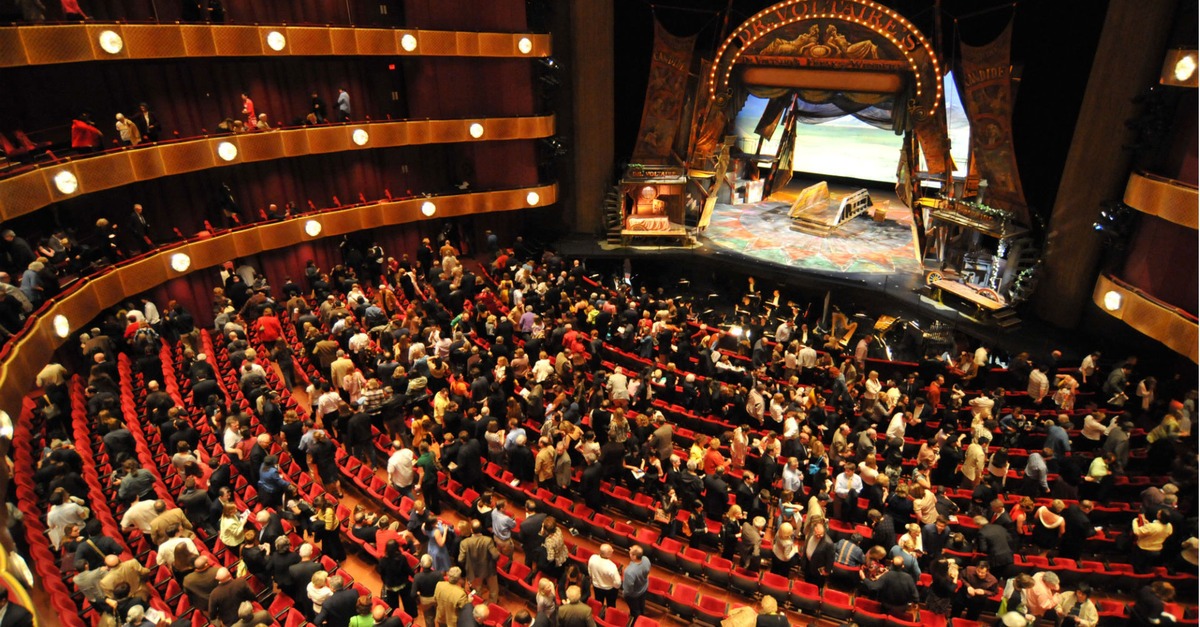 |
| Opera |
Tragedy is a form of drama based on human suffering that invokes an accompanying catharsis or pleasure in audiences. While many cultures have developed forms that provoke this paradoxical response, the term tragedy often refers to a specific tradition of drama that has played a unique and important role historically in the self-definition of Western civilisation.That tradition has been multiple and discontinuous, yet the term has often been used to invoke a powerful effect of cultural identity and historical continuity—"the Greeks and the Elizabethans, in one cultural form; Hellenes and Christians, in a common activity," as Raymond Williams puts it.
From its origins in the theatre of ancient Greece 2500 years ago, from which there survives only a fraction of the work of Aeschylus, Sophocles and Euripides; through its singular articulations in the works of Shakespeare, Lope de Vega, Jean Racine, and Friedrich Schiller to the more recent naturalistic tragedy of August Strindberg; Samuel Beckett's modernist meditations on death, loss and suffering; Müller's postmodernist reworkings of the tragic canon; and Joshua Oppenheimer's incorporation of tragic pathos in his nonfiction film, The Act of Killing (2012)
 |
| The Act of Killing (2012) |
** Watch movie : http://putlockers.ch/watch-the-act-of-killing-online-free-putlocker.html
COMEDY
In a modern sense, comedy refers to any discourse or work generally intended to be humorous or amusing by inducing laughter, especially in theatre, television, film, and stand-up comedy. The origins of the term are found in Ancient Greece. In the Athenian democracy, the public opinion of voters was influenced by the political satire performed by the comic poets at the theaters.
The theatrical genre of Greek comedy can be described as a dramatic
performance which pits two groups or societies against each other in an
amusing agon or conflict. Northrop Frye
depicted these two opposing sides as a "Society of Youth" and a
"Society of the Old". A revised view characterizes the essential agon of
comedy as a struggle between a relatively powerless youth and the
societal conventions that pose obstacles to his hopes. In this struggle,
the youth is understood to be constrained by his lack of social
authority, and is left with little choice but to take recourse in ruses
which engender very dramatic irony which provokes laughter.
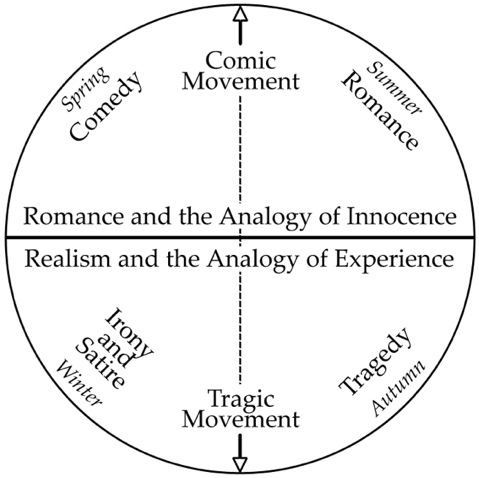 |
| Northrop Frye and Critical Method |
SAINT ANNE
 |
| Saint Anne and Mary |
Saint Anne (also known as Ann or Anna) of David's house and line, was the mother of the Mary and grandmother of Jesus according to apocryphal Christian and Islamic tradition. Mary's mother is not named in the canonical gospels, nor in the Quran. Anne's name and that of her husband Joachim come only from New Testament apocrypha, of which the Gospel of James (written perhaps around 150) seems to be the earliest that mentions them.
>> Virgin of The Rocks
The Virgin of the Rocks (sometimes the Madonna of the Rocks) is the name used for two paintings by Leonardo da Vinci, of the same subject, and of a composition which is identical except for several significant details. The version generally considered the prime version, that is the earlier of the two, hangs in The Louvre in Paris and the other in the National Gallery, London. The paintings are both nearly 2 metres (over 6 feet) high and are painted in oils. Both were painted on wooden panel; that in the Louvre has been transferred to canvas.
 |
| Louvre version |
 |
| London version |
Both paintings show the Madonna and Child Jesus with the infant John the Baptist and an angel, in a rocky setting which gives the paintings their usual name. The significant compositional differences are in the gaze and right hand of the angel. There are many minor ways in which the works differ, including the colours, the lighting, the flora, and the way in which sfumato has been used. Although the date of an associated commission is documented, the complete histories of the two paintings are unknown, and lead to speculation about which of the two is earlier.
Two further paintings are associated with the commission: side panels each containing an angel playing a musical instrument and completed by associates of Leonardo. These are both in the National Gallery, London.
Two further paintings are associated with the commission: side panels each containing an angel playing a musical instrument and completed by associates of Leonardo. These are both in the National Gallery, London.
>> The Virgin and Child with St. Anne (Leonardo)
The Virgin and Child with Saint Anne is an oil painting by Leonardo da Vinci depicting St Anne, her daughter the Virgin Mary and the infant Jesus. Christ is shown grappling with a sacrificial lamb symbolizing his Passion as the Virgin tries to restrain him. The painting was commissioned as the high altarpiece for the Church of Santissima Annunziata in Florence and its theme had long preoccupied Leonardo.
 |
| Madonna and Saint Anne |
THE FOUR APOSTLES
The Four Apostles is a panel painting by the German Renaissance master Albrecht Dürer. It was finished in 1526, and is the last of his large works. It depicts the four apostles larger-than-life-size. The Bavarian Elector Maximilian I obtained The Four Apostles in the year 1627 due to pressure on the Nuremberg city fathers. Since then, the painting has been in Munich and, despite all the efforts of Nuremberg since 1806, it has not been returned.
 |
| The Four Apostles, Albrecht Dürer, 1526 |
When Dürer moved back to Nuremberg he produced many famous paintings there, including several self-portraits. He gave The Four Apostles to the town council. Saints John and Peter appear in the left panel; the figures in the right panel are Saints Mark and Paul. Mark and Paul both hold Bibles, and John and Peter are shown reading from the opening page of John's own Gospel. At the bottom of each panel, quotations from the Bible are inscribed,
The apostles are recognizable by their symbols:
- St. John the Evangelist : open book
- St. Peter : keys
- St. Mark : scroll
- St. Paul : sword and closed book
They are also associated with the four temperaments.
- St. John : sanguine
- St. Peter : phlegmatic
- St. Mark : choleric
- St. Paul : melancholy
*CLOSE UP*


No comments:
Post a Comment