CERES (MYTHOLOGY)
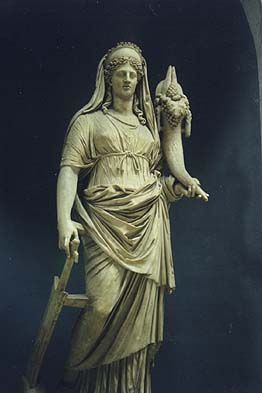 |
| Goddess of Agriculture |
In ancient Roman religion, Ceres was a goddess of agriculture, grain crops, fertility and motherly relationships. She was originally the central deity in Rome's so-called plebeian or Aventine Triad, then was paired with her daughter Proserpina in what Romans described as "the Greek rites of Ceres". Her seven-day April festival of Cerealia included the popular Ludi Ceriales (Ceres' games). She was also honoured in the May lustratio of the fields at the Ambarvalia festival, at harvest-time, and during Roman marriages and funeral rites.
Ceres is the only one of Rome's many agricultural deities to be listed among the Dii Consentes, Rome's equivalent to the Twelve Olympians of Greek mythology. The Romans saw her as the counterpart of the Greek goddess Demeter,[4] whose mythology was reinterpreted for Ceres in Roman art and literature.
DEMETER

In ancient Greek religion and Greek mythology, Demeter is the goddess of the harvest and agriculture, who presided over grains and the fertility of the earth. Her cult titles include Sito, "she of the Grain",as the giver of food or grain, and Thesmophoros (θεσμός, thesmos: divine order, unwritten law; φόρος, phoros: bringer, bearer), "Law-Bringer," as a mark of the civilized existence of agricultural society.
Though Demeter is often described simply as the goddess of the harvest, she presided also over the sacred law, and the cycle of life and death. She and her daughter Persephone were the central figures of the Eleusinian Mysteries that predated the Olympian pantheon. In the Linear B Mycenean Greek tablets of circa 1400–1200 BC found at Pylos, the "two mistresses and the king" may be related with Demeter, Persephone and Poseidon. Her Roman equivalent is Ceres.
NAUSICAA
 |
| Odysseus and Nausicaa |
Nausicaa is a character in Homer's Odyssey. She is the daughter of King Alcinous and Queen Arete of Phaeacia. Her name, in Greek, means "burner of ships". She is young and very pretty; Odysseus says that she resembles a goddess, particularly Artemis. Nausicaä is known to have several brothers. According to Aristotle and Dictys of Crete, Nausicaä later married Telemachus, the son of Odysseus, and had a son named Ptoliporthus.
CIRCE

Circe is a goddess of magic (or sometimes a nymph, witch, enchantress or sorceress). By most accounts, Circe was the daughter of Helios, the god of the sun, and Perse, an Oceanid. Her brothers were Aeetes, the keeper of the Golden Fleece, and Perses. Her sister was Pasiphaë, the wife of King Minos and mother of the Minotaur. Other accounts make her the daughter of Hecate, the goddess of witchcraft herself.
Circe was renowned for her vast knowledge of potions and herbs. Through the use of these and a magic wand or a staff, she transformed her enemies, or those who offended her, into any kind of animals. Some say she was exiled to the solitary island of Aeaea by her subjects and her father Helios for killing her husband, the prince of Colchis. Later traditions tell of her leaving or even destroying the island and moving to Italy, where she was identified with Cape Circeo.

CLYPSO
Calypso was a nymph in Greek mythology, who lived on the island of Ogygia, where she detained Odysseus for several years. She is generally said to be the daughter of the Titan Atlas.
Hesiod, and the Homeric Hymn to Demeter, mention either a different Calypso or possibly the same Calypso as one of the Oceanid daughters of Tethys and Oceanus. Apollodorus includes the name Calypso in his list of Nereids, the daughters of Nereus and Doris.
 |
| Calypso receiving Telemachus and Mentor in the Grotto |
*CLOSE UP*
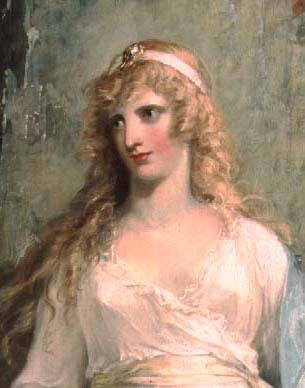
MOIRAE
 |
| The Three Fates Clotho, Lachesis and Atropos |
In Greek mythology, the Moirai or Moerae (Ancient Greek: "apportioners"), often known in English as the Fates (Latin: Fatae), were the white-robed incarnations of destiny; their Roman equivalent was the Parcae ("sparing ones"). Their number became fixed at three: Clotho (spinner), Lachesis (allotter) and Atropos (unturnable).
They controlled the mother thread of life of every mortal from birth to death. They were independent, at the helm of necessity, directed fate, and watched that the fate assigned to every being by eternal laws might take its course without obstruction. The gods and men had to submit to them, although Zeus's relationship with them is a matter of debate: some sources say he is the only one who can command them (the Zeus Moiragetes), yet others suggest he was also bound to the Moirai's dictates. In the Homeric poems Moira or Aisa, is related with the limit and end of life, and Zeus appears as the guider of destiny. In the Theogony of Hesiod, the three Moirai are personified, daughters of Nyx and are acting over the gods. Later they are daughters of Zeus and Themis, who was the embodiment of divine order and law. In Plato's Republic the Three Fates are daughters of Ananke (necessity).
*CLOSE UP*
 |
| Lachesis |
 |
| Clotho |
 |
| Atropos |
 IRIS
IRIS
In Greek mythology, Iris is the personification of the rainbow and messenger of the gods. She is also known as one of the goddesses of the sea and the sky. Iris links the gods to humanity. She travels with the speed of wind from one end of the world to the other, and into the depths of the sea and the underworld.
ERIS
Eris is the Greek goddess of strife and discord. Her name is the equivalent of Latin Discordia, which means "discord". Eris' Greek opposite is Harmonia, whose Latin counterpart is Concordia. Homer equated her with the war-goddess Enyo, whose Roman counterpart is Bellona. The dwarf planet Eris is named after the goddess, as is the religion Discordianism.
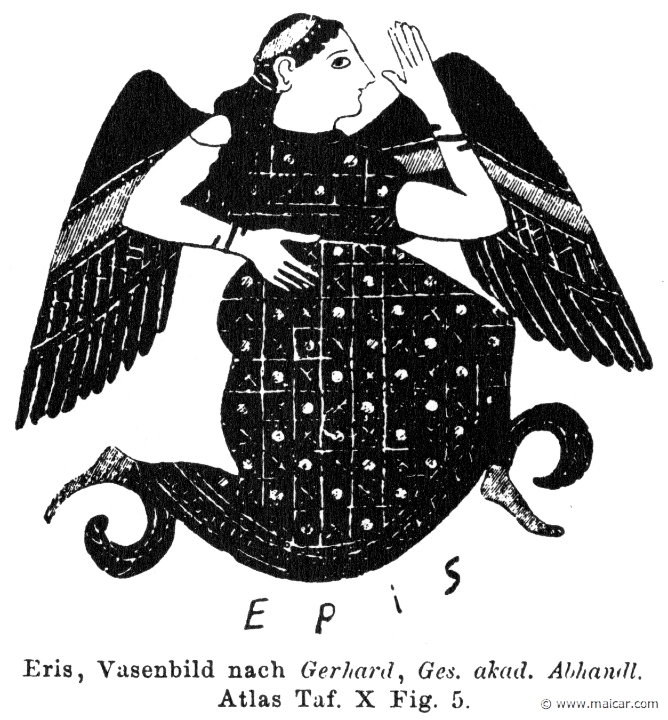 |
| Goddess of Chaos, Strife, Discord |
METAMORPHOSES
The Metamorphoses (Latin: Metamorphōseōn librī: "Books of Transformations") is a Latin narrative poem by the Roman poet Ovid, considered his magnum opus. Comprising fifteen books and over 250 myths, the poem chronicles the history of the world from its creation to the deification of Julius Caesar within a loose mythico-historical framework.
One of the most influential works in Western culture, the Metamorphoses has inspired such authors as Dante Alighieri, Giovanni Boccaccio, Geoffrey Chaucer, and William Shakespeare. Numerous episodes from the poem have been depicted in acclaimed works of sculpture, painting, and music. Although interest in Ovid faded after the Renaissance, there was a resurgence of attention to his work towards the end of the twentieth century; today, the Metamorphoses continues to inspire and be retold through various media. The work has been the subject of numerous translations into English, the first by William Caxton in 1480.
 |
| OVID's METAMORPHOSES |
ASCLEPIUS
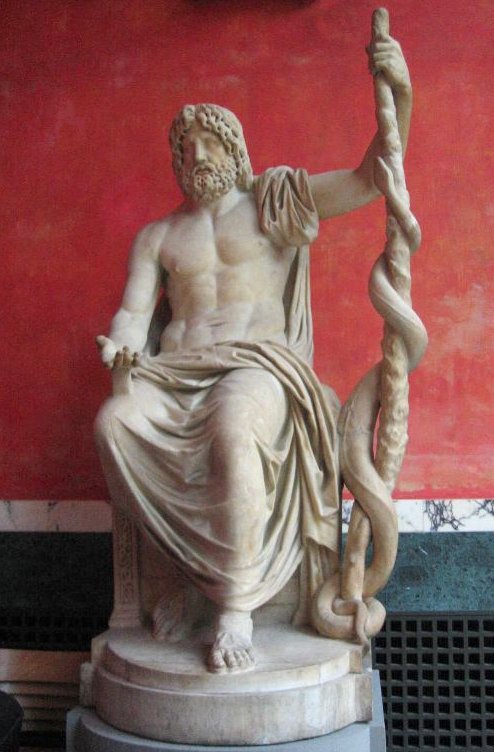 |
| God of medicine, healing, rejuvenation and physicians |
Asclepius was a hero and god of medicine in ancient Greek religion and mythology. Asclepius represents the healing aspect of the medical arts; his daughters are Hygieia ("Hygiene", the goddess/personification of health, cleanliness, and sanitation), Iaso (the goddess of recuperation from illness), Aceso (the goddess of the healing process), Aglæa/Ægle (the goddess of beauty, splendor, glory, magnificence, and adornment), and Panacea (the goddess of universal remedy). He was associated with the Roman/Etruscan god Vediovis and the Egyptian Imhotep. He was one of Apollo's sons, sharing with Apollo the epithet Paean ("the Healer"). The rod of Asclepius, a snake-entwined staff, remains a symbol of medicine today. Those physicians and attendants who served this god were known as the Therapeutae of Asclepius.
 |
Hippocrates of Kos (c. 460 – c. 370 BC), also known as Hippocrates II, was a Greek physician of the Age of Pericles (Classical Greece), and is considered one of the most outstanding figures in the history of medicine. He is referred to as the "Father of Modern Medicine" in recognition of his lasting contributions to the field as the founder of the Hippocratic School of Medicine.
This intellectual school revolutionized medicine in ancient Greece, establishing it as a discipline distinct from other fields with which it had traditionally been associated (theurgy and philosophy), thus establishing medicine as a profession. However, the achievements of the writers of the Corpus, the practitioners of Hippocratic medicine, and the actions of Hippocrates himself were often commingled; thus very little is known about what Hippocrates actually thought, wrote, and did.
Hippocrates is commonly portrayed as the paragon of the ancient physician, and credited with coining the Hippocratic Oath, still relevant and in use today. He is also credited with greatly advancing the systematic study of clinical medicine, summing up the medical knowledge of previous schools, and prescribing practices for physicians through the Hippocratic Corpus and other works.
 |
| Hippocrates Oath |
 |
| Ancient School of Medicine is called the ‘Askleipion’ |
 |
** PREFIX, ROOT, SUFFIX **
audi : to listen
audience : a group of people who gather together to listen something
auditorium : a large room or building where people gather to watch performance
auditory : a relating to hearing or the ears
spec : to look
spectator : causing wonder and admiration
inspect : to look carefully
perspective : opinion
arch : principal, order; early, primitive
architect : a person who design building
anarchy : without order

No comments:
Post a Comment